
Working Whilst on Disability Benefits

Published · 7 min read
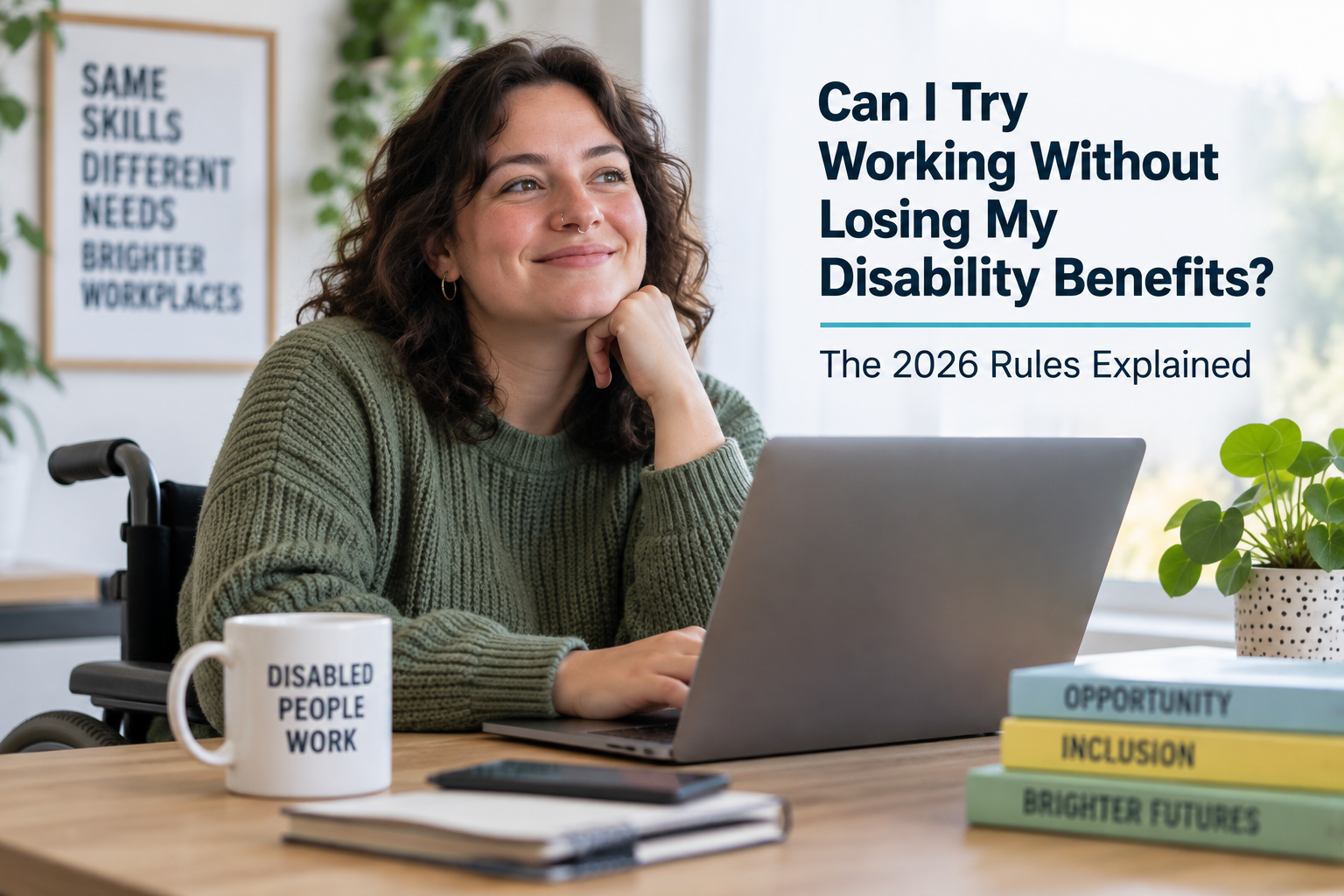
Can I Try Working Without Losing My Disability Benefits? The 2026 Rules Explained
If you receive disability benefits, trying to return to work can feel like a financial gamble.
What if you take a job and discover that your health won't allow you to continue? Could starting work trigger a benefit review? And does being able to work suggest that you no longer need disability support?
These worries can stop people from trying work at all.
New rules introduced in April 2026 are designed to change that.
Known as Right to Try, the rules mean that for people already receiving certain disability and health-related benefits, starting work or volunteering will not, by itself, trigger a reassessment.
That doesn't mean work can never affect your benefits. Earnings can still change the amount of Universal Credit you receive, for example.
But simply trying to work shouldn't automatically put your disability benefit entitlement at risk.
Here's how it works.
What changed in April 2026?
On 30 April 2026, new Right to Try protections came into force.
The change was introduced to tackle a problem that many disabled people will recognise: being afraid to try work because of what might happen to their benefits.
Right to Try is intended to provide more reassurance.
Starting a job or volunteering, on its own, is no longer a reason to trigger a reassessment for people covered by the new rules.
Who does Right to Try apply to?
The new protection applies to people already receiving Personal Independence Payment (PIP).
It also covers people receiving Universal Credit who have already been assessed as having Limited Capability for Work (LCW) or Limited Capability for Work and Work-Related Activity (LCWRA).
Some people receiving New Style Employment and Support Allowance (ESA) are covered too, including those in the Support Group or Work-Related Activity Group.
There are exceptions — particularly for people who are still waiting for their first Work Capability Assessment.
But for many existing claimants, the important message is simple:
Trying work does not automatically mean being reassessed.
Can I work and still receive PIP?
Yes.
This is perhaps the most important misconception to clear up.
PIP isn't an out-of-work benefit.
It is intended to help with the additional costs and difficulties associated with a long-term health condition or disability.
It isn't means-tested, which means your earnings and savings do not normally determine whether you can receive it.
You can therefore receive PIP while working, including working full-time.
Your entitlement is based on how your condition affects you, rather than whether you have a job.
Can working ever affect my PIP?
Working itself doesn't automatically reduce PIP.
However, what you do at work could be relevant when your PIP is reviewed in the future.
Suppose your PIP claim says you have significant difficulty carrying out a particular activity, but your job appears to involve doing something similar regularly.
An assessor could ask about that.
There may be a perfectly reasonable explanation.
Perhaps you use specialist equipment. Maybe a colleague helps you. You might work from home, take frequent breaks or only perform the task occasionally.
The important thing is that your work and the difficulties described in your PIP claim should give an accurate picture of your circumstances.
What about Universal Credit?
Universal Credit works differently because your earnings can affect how much you receive.
You can still work while claiming Universal Credit, and there isn't a fixed number of hours that automatically stops your claim.
Instead, your payment generally reduces gradually as your earnings increase.
Some people with a health condition or disability also receive a work allowance.
This is an amount you can earn before your Universal Credit starts reducing.
For 2026/27, the monthly work allowance is:
£427 if your Universal Credit includes help with housing costs.
£710 if it doesn't.
Once you've earned more than your work allowance, your Universal Credit usually reduces by 55p for every additional £1 you earn.
What if I'm receiving ESA?
People receiving Employment and Support Allowance may also be able to work under the permitted work rules.
In 2026/27, you can generally do permitted work if you:
work for less than 16 hours per week and earn no more than £203.50 per week after tax and National Insurance.
In many cases, you can continue receiving your normal ESA while doing permitted work.
The rules can vary depending on your circumstances, however, so it's important to check before starting.
What if I try working and can't manage it?
This is exactly the kind of situation Right to Try is intended to help with.
Disability and long-term illness aren't always predictable.
You might think you can manage three days a week and discover that one day is your limit.
You might find that travelling to work causes more difficulty than the job itself.
Or you might simply discover that a particular job isn't suitable.
Trying work and finding that you cannot manage it doesn't mean you were wrong about your disability.
It means you tried.
The 2026 rules are designed to make that decision less frightening by removing the automatic link between starting work and being reassessed.
Can the DWP still reassess me?
Yes.
Right to Try doesn't mean you'll never have another assessment.
Normal scheduled benefit reviews can still take place.
A reassessment may also happen for other reasons, such as reporting a significant change in your condition or where there is evidence suggesting your circumstances have changed.
Any review that was already planned can still happen too.
The important distinction is this:
Starting work or volunteering should not, on its own, trigger the reassessment.
Do I still need to tell the DWP that I'm working?
Where the rules require you to report a change, yes.
Right to Try doesn't remove the normal requirement to tell the DWP about relevant changes to your circumstances.
For example, if you're claiming Universal Credit and start or leave a job, you should report the change.
Employers usually report your earnings automatically through PAYE, but you still need to follow the normal rules for your benefit.
Right to Try protects the act of trying work from automatically triggering a reassessment.
It doesn't mean that work or earnings should be kept from the DWP.
What about volunteering?
The new protection isn't limited to paid employment.
Starting voluntary work should not, by itself, trigger a reassessment either.
That could be particularly helpful for somebody who isn't ready for paid employment but wants to test their stamina, rebuild confidence, develop new skills or simply get back into a routine.
Again, the normal rules around your individual benefits still apply.
Help may be available to make work possible
Sometimes the question isn't whether somebody can work.
It's whether the right support is available to allow them to work.
That's where Access to Work can help.
Access to Work is a government scheme that can provide practical support for disabled people and people with physical or mental health conditions.
Depending on your circumstances, that could include help with specialist equipment, workplace support or additional travel costs.
It can support people with many different conditions and disabilities, including autism, ADHD, dyslexia, hearing or sight loss, physical disabilities and mental health conditions.
And importantly, you don't always need a formal diagnosis to apply.
Why has the Government made this change?
The reasoning behind Right to Try is fairly straightforward.
If trying work feels as though it could threaten someone's financial security, some people simply won't take the risk.
That can leave disabled people in an unfair position.
They may feel capable of trying a small amount of work but not confident that they could sustain it permanently.
The Government wants people to be able to test what they're capable of without the act of trying automatically triggering a reassessment.
So, can I try working without losing my disability benefits?
For many people, yes.
The key thing is understanding which type of benefit you receive.
If you receive PIP, you can work and continue receiving PIP. Your earnings don't automatically reduce your award.
If you receive Universal Credit, you can work, although your earnings may reduce the amount of Universal Credit you're paid.
If you receive ESA, you may be able to do permitted work within specific limits.
And since 30 April 2026, Right to Try means that for people covered by the new rules, simply starting work or volunteering should not trigger a benefit reassessment.
For somebody who has been out of work because of disability or ill health, returning to employment doesn't always happen in one big jump.
The purpose of Right to Try is to give disabled people more freedom to explore those possibilities without feeling that simply trying could immediately put their disability benefit entitlement at risk.
Because being able to try work and needing disability support aren't mutually exclusive.
You can be disabled and work. You can need support and work. And sometimes, the only way to discover what you're capable of is to have the opportunity to try.
This article provides general information about benefits in Great Britain as of September 2026. Benefit rules and individual circumstances vary, so check current government guidance or seek independent benefits advice before making financial decisions.