
More Than Companions: How Therapy and Assistance Animals Change Lives
23 September 2026 · 8 min read
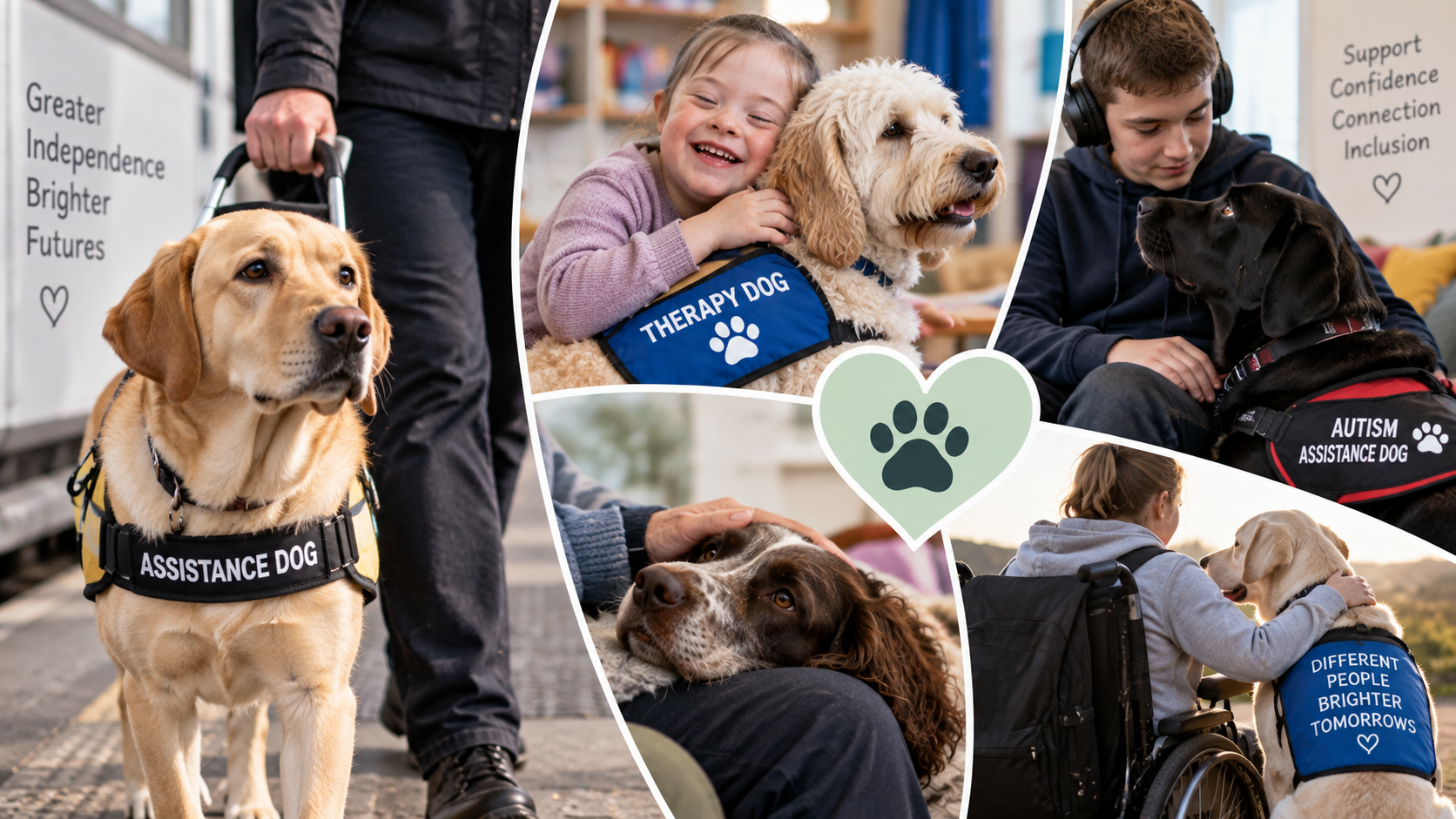
The Life-Changing Work of Therapy and Assistance Animals
For many of us, animals provide companionship, comfort and an excuse to get outside.
But for thousands of people across the UK, an animal can play a much bigger role.
From guide dogs helping people with sight loss navigate safely to medical alert dogs trained to respond to changes in someone's health, animals are supporting people to live with greater independence and confidence.
Elsewhere, therapy animals regularly visit hospitals, schools, care homes and other community settings, providing companionship and opportunities for positive interaction.
But although the terms therapy animal and assistance animal are sometimes used interchangeably, they describe very different roles.
Understanding that difference helps us appreciate just how varied — and highly skilled — their work can be.
Assistance animals vs therapy animals: what's the difference?
An assistance dog is trained to carry out specific tasks that help an individual with needs relating to their disability or health condition.
Government guidance lists recognised assistance dogs including guide dogs, hearing dogs, autism assistance dogs, medical alert dogs, physical disability assistance dogs, PTSD and psychiatric assistance dogs, allergy alert dogs and dementia assistance dogs. Emotional-support dogs that provide comfort without being trained to perform disability-related tasks are not generally considered recognised assistance dogs for purposes such as travel.
A therapy animal, by comparison, generally visits and interacts with multiple people rather than being individually trained to mitigate one person's disability.
A therapy dog might visit a care home one morning and a school another day, for example. Its role can involve providing companionship and positive interaction alongside its volunteer handler.
That difference is important when discussing public-access rights too.
Guide dogs: providing independence through partnership
Guide dogs are perhaps the UK's most recognisable assistance animals.
Their work is far more sophisticated than simply leading someone from one place to another.
A guide dog can help its handler navigate obstacles and move confidently through everyday environments. The relationship is a partnership: Guide Dogs carefully matches dogs with people according to factors including their mobility, daily routine, lifestyle and future plans.
At the end of 2024, there were 3,197 working guide dog partnerships in the UK, alongside 347 active buddy-dog partnerships supporting young people with sight loss.
The numbers continue to develop. In 2025, Guide Dogs reports that it created 553 new guide dog partnerships, 7% more than in 2024, and supported 351 buddy-dog partnerships.
And producing a successful partnership requires a huge amount of work.
In 2024, Guide Dogs' breeding programme produced 1,379 puppies. More than four-fifths of the puppies placed with volunteer puppy raisers successfully progressed into the formal guide-dog training programme.
Assistance dogs can do much more than guide
Not every assistance dog wears the familiar white guide-dog harness.
Depending on their training and the person's needs, assistance dogs can perform an extraordinary range of tasks.
A physical-assistance dog might retrieve dropped objects, open or close doors, help with dressing or perform other trained tasks that increase independence.
Hearing dogs can alert people to important sounds.
Medical alert dogs can be trained to respond to health-related changes or events.
Other assistance dogs work alongside autistic people or individuals with psychiatric conditions, PTSD or dementia.
The common factor is purposeful training.
These dogs aren't simply providing companionship, valuable though companionship may be. They have been trained to perform specific tasks relating to an individual's disability or health needs.
Therapy animals do something different
Therapy animals aren't assistance animals, but their work can still be extremely valuable.
One of the UK's best-known organisations in this area is Pets As Therapy (PAT), a national charity coordinating therapeutic visits with volunteers and their pets.
The scale of that work is striking.
Current figures published by PAT report:
- 6,227 volunteers
- 6,694 places receiving regular PAT visits
- more than 631,000 people meeting a PAT pet
- 1,969 assessed PAT pets.
These animals and their volunteer handlers visit settings where interaction with a calm, friendly animal can provide moments of connection and companionship.
Therapy animals in education
One area where therapy animals have become increasingly visible is education.
Some schools, colleges and universities use carefully managed animal-visiting programmes as part of wider wellbeing initiatives.
For some pupils, simply sitting quietly with an animal can provide a different kind of interaction from the usual school environment.
Animals can also provide a shared focus. Instead of a conversation being entirely centred on the pupil, the animal becomes something to talk about, interact with or care for.
This can be particularly useful in settings where staff are trying to create calm, positive opportunities for engagement.
However, therapy animals shouldn't be viewed as a substitute for qualified teachers, SEND professionals, counsellors, therapists or healthcare practitioners.
They are best understood as one potential component of a much wider support environment.
Supporting children and young people with SEND
Animals can also play different roles in the lives of children and young people with special educational needs and disabilities (SEND).
For some families, an appropriately trained assistance dog may support independence, safety or specific disability-related needs.
For others, interacting with a therapy animal through school or another organisation may simply provide a positive, structured experience.
And sometimes a pet is simply a much-loved pet.
Those distinctions matter.
We shouldn't automatically describe every animal that helps a child with SEND as a "therapy animal" or "assistance animal". Each term has a particular meaning, and assistance work requires specialist training.
What happens when an assistance dog is working?
One of the simplest ways the public can support an assistance-dog partnership is to understand that a working dog is working.
A guide or assistance dog may look friendly — and very often is — but distracting it can interfere with the job it is performing.
That means you shouldn't automatically:
stroke the dog, call its name, whistle at it, offer food or allow another dog to distract it.
If you'd like to interact with an assistance dog, ask the handler first.
And don't be offended if the answer is no.
The handler isn't being unfriendly. Their dog may need to concentrate.
Access isn't a special favour
Assistance dogs also need to accompany their handlers into many places where ordinary pet dogs would not usually be permitted.
Guide Dogs explains that qualified assistance-dog partnerships can access almost all premises and transport, subject to limited exceptions, and that businesses and service providers have obligations relating to disabled customers under equality legislation.
For travel into Great Britain, government guidance similarly recognises trained assistance dogs and notes that they can use some forms of transport from which ordinary pets are excluded, including travelling in an aircraft cabin on applicable routes.
There can be exceptions, particularly around strictly sterile or food-preparation environments, but the underlying principle is important:
the dog is enabling the person to access everyday life.
Training takes time
The calm behaviour we associate with assistance dogs doesn't happen overnight.
Dogs need to learn appropriate behaviour in environments that can include busy streets, shops, restaurants, public transport and workplaces.
Guide Dogs, for example, uses volunteer puppy raisers before dogs progress into formal training. Specialist staff then train and ultimately match suitable dogs with people with sight loss.
Even after matching, the process isn't finished.
The person and dog need to learn to work effectively together, creating a genuine partnership rather than simply handing a trained animal to somebody.
In 2024, Guide Dogs reported a 92% success rate for its five-week tailored training period with new owners, up from 88% the previous year.
Not every animal will become an assistance animal
An equally important part of responsible assistance-dog programmes is recognising when a particular dog isn't suited to the work.
Working assistance dogs need the appropriate temperament, health and ability to cope comfortably with the demands placed upon them.
Animal welfare therefore has to sit alongside human benefit.
The objective isn't to force every puppy through a training programme. It's to identify animals that can perform the role successfully while maintaining their own physical and emotional wellbeing.
Guide Dogs explicitly describes the dog's health and wellbeing as central to creating a successful partnership.
The numbers tell only part of the story
Statistics can demonstrate the scale of these services.
More than 3,000 working guide-dog partnerships, hundreds of new partnerships each year and hundreds of thousands of encounters with Pets As Therapy animals give us an indication of how many lives animals are touching across the country.
But numbers don't capture everything.
They don't capture the person who can travel somewhere independently.
Or the child who looks forward to an animal visiting their school.
Or the individual who can perform an everyday activity with assistance they didn't previously have.
And they don't capture the enormous contribution of trainers, volunteers, handlers and organisations working behind the scenes.
How can you support their work?
You don't need to train an assistance dog yourself to make a difference.
Organisations working with assistance and therapy animals depend heavily on volunteers, supporters and donations.
Depending on the organisation, opportunities can include puppy raising, fundraising, volunteering with a suitable pet, helping at events or supporting awareness campaigns.
Pets As Therapy, for example, operates through thousands of volunteers and assessed pets across the UK.
Guide Dogs also relies on volunteers throughout different stages of its dogs' development and wider charitable work.
If you're interested in getting involved, always approach an established organisation directly rather than assuming that a friendly family pet will automatically be suitable for therapeutic or assistance work.
Small paws, enormous impact
The phrase "man's best friend" doesn't really capture what some animals do.
An assistance dog can be a highly trained working partner, helping someone navigate a world that isn't always designed around their needs.
A therapy animal can provide moments of companionship and connection to people in schools, hospitals, care environments and communities.
The roles are different, but both demonstrate the extraordinary relationships that can develop between people and animals.
Perhaps the most important thing for the rest of us is to understand and respect those relationships.
Don't distract a working assistance dog. Don't assume every support animal performs the same role. And remember that behind every successful partnership are months or years of training, commitment and care.
Because sometimes four paws can open doors to far more than companionship — they can help create confidence, connection and independence.