Celebrating Differently: A SEND-Friendly Guide to Halloween, Bonfire Night & Beyond
21 September 2026 · 9 min read
Halloween, Bonfire Night and SEND: A Practical Guide for Parents and Carers
For many families, autumn means costumes, trick-or-treating, bonfires, fireworks and parties. But for some children and young people with special educational needs and disabilities (SEND), Halloween and Bonfire Night can bring a very different experience.
Unexpected knocks at the door. Flashing lights. Crowds. Costumes and masks. Strong smells. Loud music. And, of course, fireworks that can happen without warning.
For children and young people who experience sensory sensitivities, anxiety, communication difficulties or find changes to routine challenging, what is supposed to be a celebration can quickly become overwhelming.
The good news is that celebrating doesn't have to look the same for every family.
With some preparation, flexibility and a few practical strategies, parents and carers can make Halloween, Bonfire Night and other celebrations feel safer and more predictable — without putting pressure on a child to experience them in a particular way.
Why can Halloween be difficult for someone with SEND?
Halloween involves a surprising number of changes to everyday life.
People dress differently. Familiar houses suddenly have decorations, lights and sounds. Strangers may wear masks. Children are encouraged to knock on unfamiliar doors. Other people unexpectedly knock at yours.
For some autistic children and young people, or those with sensory processing differences, ADHD, learning disabilities or anxiety, this combination can be difficult to process.
Costumes can also create sensory challenges. Face paint may feel uncomfortable, masks can restrict vision or breathing, and unfamiliar fabrics, seams, labels and accessories may be irritating.
And then there is the unpredictability.
Halloween doesn't always follow a timetable. A doorbell might ring just as someone is settling down for the evening. Decorations might move or make noise unexpectedly.
The first step towards making celebrations more accessible is recognising that a reaction isn't necessarily about someone "not liking Halloween". There may be a specific part of the experience that is causing discomfort.
Bonfire Night brings a different sensory challenge
Fireworks are deliberately designed to be intense.
They're bright, loud and unpredictable. Even when attending an organised display, it can be difficult to know exactly when the next explosion will happen.
For somebody with heightened sensitivity to sound, that unpredictability can be particularly challenging.
Bonfire Night can also extend well beyond 5 November. Fireworks may be heard during the days and weekends surrounding Bonfire Night, as well as around Diwali, New Year's Eve and private celebrations.
That means preparation shouldn't focus solely on one evening.
1. Make the unfamiliar familiar
One of the most useful things parents and carers can do is explain what is going to happen before it happens.
Rather than simply saying, "We're going to see fireworks," break the experience into smaller stages.
You might explain that you'll put coats on, travel to the event, there will be lots of people, you may need to queue, it might smell smoky, fireworks will make loud bangs and bright flashes, and then you'll travel home.
Pictures, videos, visual schedules or social stories can help make an unfamiliar experience more predictable.
You could also look at photographs of the location beforehand or, if possible, visit it when there isn't an event taking place.
The aim isn't to remove every surprise. It's to reduce the number of unknowns.
2. Prepare for sensory needs
Think about the environment from your child or young person's perspective.
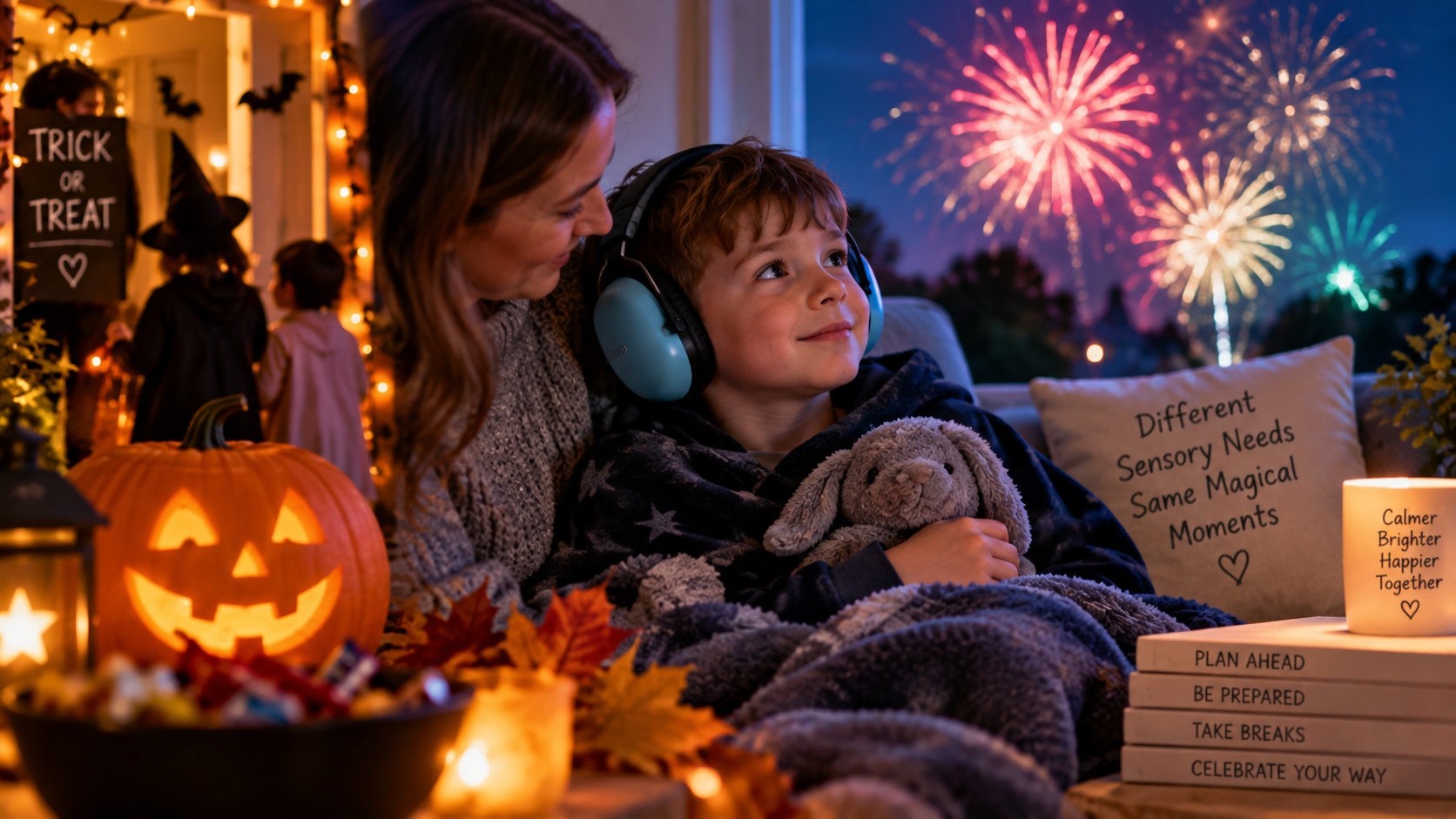
For fireworks, ear defenders or noise-reducing headphones may help. If they already use these successfully, make sure they're packed before leaving home.
Other useful items might include sunglasses or a peaked cap for bright lights, a favourite sensory or fidget item, a familiar blanket, a communication aid, a drink and a familiar snack.
Halloween costumes can also be adapted.
There is no rule saying a costume has to include a mask, face paint or an uncomfortable outfit. A Halloween-themed T-shirt, familiar clothes in particular colours or a favourite comfortable outfit can work just as well.
Comfort is more important than getting the perfect photograph.
3. Practise before the event
Rehearsal can make unfamiliar situations easier.
Before Halloween, you could practise knocking on your own front door and saying "trick or treat". You might role-play somebody answering the door or practise what happens if the person doesn't answer.
If your child uses alternative or augmentative communication, make sure they have an appropriate way to participate without being expected to speak.
You can do something similar with fireworks.
Watching a short fireworks video at a comfortable volume may help explain what will happen. But don't use exposure as a test that someone has to "pass". If it causes distress, stop.
Preparation should build familiarity, not force tolerance.
4. Create an escape plan
Knowing you can leave can sometimes make attending an event easier.
Before going to a Halloween party, fireworks display or community event, think about where you can go if things become overwhelming.
At an organised event, look for quieter areas away from speakers, crowds and the main display.
If you're travelling by car, consider parking somewhere that allows you to leave without getting trapped in the busiest part of the car park.
Most importantly, agree that leaving early is an option.
Staying for the entire event isn't the measure of whether the evening was successful.
Twenty enjoyable minutes can be far better than two overwhelming hours.
5. Consider celebrating from home
You don't have to attend a large fireworks display to participate in Bonfire Night.
Watching fireworks through a window from a familiar environment may be much more comfortable. Some families watch televised displays or videos where the volume can be controlled.
Similarly, Halloween doesn't have to involve trick-or-treating.
You could have a Halloween film night, decorate pumpkins, make Halloween-themed food, organise a treasure hunt at home or let a child hand out treats if they prefer that to knocking on doors.
Participation can be adapted around the person.
6. Make home feel predictable
Even families who aren't celebrating can be affected by Halloween and Bonfire Night.
If unexpected knocks are difficult, consider placing a polite sign on the door explaining that you aren't participating in trick-or-treating.
You might also temporarily disconnect or silence a doorbell where practical.
For fireworks, closing curtains can reduce flashes and putting on familiar television, music or background noise may help reduce the contrast between a quiet home and sudden bangs outside.
Creating a familiar, comfortable space with favourite objects, blankets, lighting or sensory equipment can provide somewhere to retreat.
7. Watch for the early signs of overwhelm
It can be easier to respond to overload before it reaches crisis point.
Every person is different, but changes might include covering ears, becoming quieter or more vocal, repetitive movements increasing, pacing, trying to leave, becoming irritable, withdrawing or struggling to communicate.
These behaviours can be communication.
Instead of focusing first on stopping the behaviour, ask what the behaviour might be telling you.
Is it too loud? Too crowded? Too hot? Has the event gone on too long? Does the person need food, a toilet, movement, quiet or simply to go home?
8. Build in recovery time
A celebration can be tiring even when it goes well.
Someone may have coped with noise, crowds and changes while they were out but need significant downtime afterwards.
Try not to fill every part of the day.
If you're going to a fireworks display in the evening, for example, keeping the afternoon relatively calm may help. After a busy event, allow time for preferred activities, familiar routines and rest.
The same principle can be useful after Christmas parties, birthdays, weddings, school events and family gatherings.
9. Let the individual have some control
Choice can reduce anxiety.
Where appropriate, offer clear options such as:
"Would you like to watch from here or move further away?"
"Costume or normal clothes?"
"Stay for another five minutes or go home?"
Too many open-ended choices can sometimes be overwhelming, so offering two clear alternatives may work better.
And where somebody communicates that they have had enough, listen.
10. Don't compare their experience with somebody else's
One child may love fireworks but dislike Halloween costumes.
Another may enjoy dressing up but find people knocking at the door frightening.
Someone else may adore Christmas lights but struggle with the noise and number of people at a family gathering.
SEND is incredibly varied, and sensory needs are individual.
Even siblings with the same diagnosis may experience the same event completely differently.
The goal isn't to teach someone to celebrate "normally". It is to find a way of participating — or choosing not to participate — that works for them.
Beyond Halloween: creating a SEND-friendly celebration toolkit
Many of the strategies that help during Halloween and Bonfire Night can be transferred to almost any celebration.
Christmas brings different food, visitors, decorations, music, changes to school and work routines and unfamiliar expectations.
Birthdays can mean crowds, singing, candles, presents and attention.
Weddings can involve formal clothes, long periods of waiting, unfamiliar locations and loud receptions.
Festivals and religious celebrations may introduce crowds, smells, lights, music and changes to routine.
New Year's Eve brings another period of unpredictable fireworks.
Rather than creating an entirely new plan every time, families can develop a personal celebration toolkit.
That might include:
- ear defenders or headphones
- a visual schedule or social story
- familiar snacks and drinks
- sensory or comfort items
- communication aids
- comfortable clothing
- a quiet-space plan
- an agreed signal or way to communicate "I need a break"
- an exit plan
- recovery time afterwards.
Over time, parents and carers can learn which elements consistently help and adapt them to different situations.
Try the "Before, During, After" approach
One simple framework can make planning easier.
Before: Explain what will happen, use visual information where helpful, discuss sensory challenges, pack useful items and agree an exit plan.
During: Watch for signs of overload, offer choices, take breaks, reduce sensory input where possible and be prepared to change the plan.
After: Provide recovery time, return to familiar routines and, when appropriate, talk about what worked and what could be different next time.
That final stage is particularly useful.
Instead of asking only, "Did you enjoy it?", consider more specific questions:
What was your favourite part? What was too loud? Was there anywhere you felt comfortable? What should we bring next time?
For someone who doesn't communicate verbally, observation and alternative communication methods can help answer those questions too.
When plans change, that's OK
Perhaps one of the most useful things families can take into any celebration is flexibility.
You might spend weeks preparing for a fireworks display and leave after ten minutes.
A Halloween costume might stay in the wardrobe.
A Christmas party might become too much after half an hour.
That's not necessarily a failed experience.
Sometimes success means recognising a person's limits and responding to them.
Every positive experience also provides information for the next one.
Celebrations should be about belonging, not enduring
Halloween and Bonfire Night can be wonderful experiences, but nobody should have to endure overwhelming sensory or emotional distress simply because an activity is traditionally considered fun.
For children and young people with SEND, small adjustments can make a significant difference.
Prepare early. Make things predictable. Reduce unnecessary sensory demands. Bring familiar comforts. Plan a way out. Allow recovery time.
And above all, follow the individual rather than the tradition.
The best celebration isn't necessarily the biggest, loudest or longest.
It's the one where the person feels safe, included and able to take part in a way that works for them.