
Tonga's New Disability Rights
By Amos Miller, founder of Buzzbo · 8 October 2026 · 4 min read
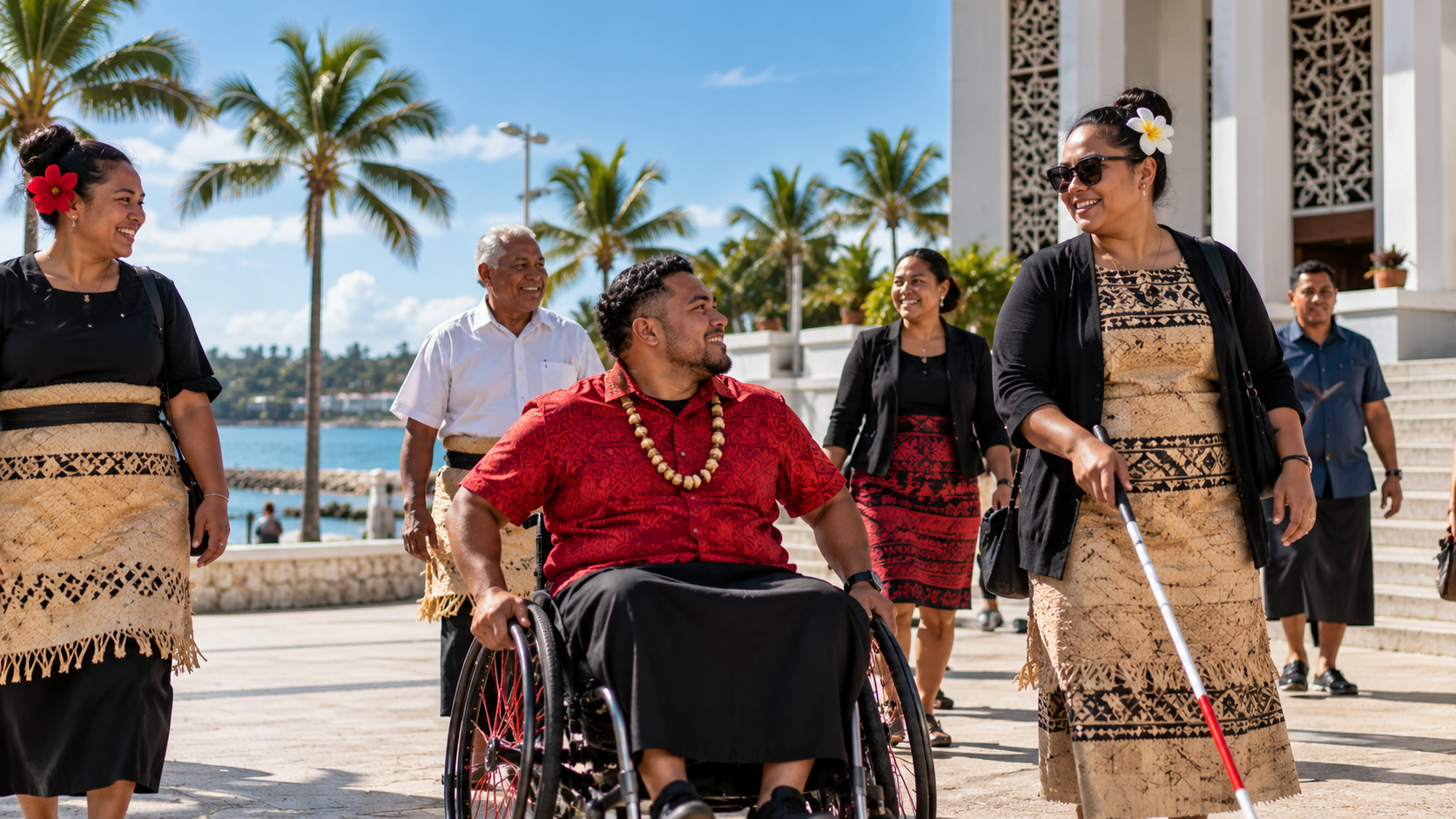
Tonga’s disability-rights treaty takes effect on 4th October — a landmark, but not the end of the story
On Sunday, 4 October, Tonga formally enters a new chapter in disability rights. The UN Convention on the Rights of Persons with Disabilities — the CRPD — will enter into force for the Pacific island kingdom, one month after Tonga deposited its instrument of ratification with the United Nations.
That may sound like the technical end of a diplomatic process. For disabled Tongans, however, the important question begins now: what does ratification actually change in everyday life?
The basic facts are clear. Tonga signed the CRPD in November 2007 but did not ratify it until 4 September 2026. The UN Treaty Collection records that ratification, while the International Disability Alliance confirms that the convention enters into force for Tonga on 4 October 2026.
The significance of the convention is difficult to overstate. The CRPD establishes that disabled people are holders of human rights rather than passive recipients of welfare or charity. It covers areas including equality before the law, accessibility, education, healthcare, employment, independent living, political participation and protection from discrimination.
For a geographically dispersed Pacific nation, implementation presents particular challenges. Tonga consists of islands and island groups separated by considerable distances, and accessibility cannot simply mean improving services in the capital. The International Disability Alliance has specifically argued that implementation must reach communities from Tongatapu to Vavaʻu, Haʻapai, ʻEua and the Niuas, including disabled people living in rural and remote communities.
There is a strong positive story here. Organisations of persons with disabilities have spent years advocating for ratification, and the International Disability Alliance credited Tongan disability organisation LATA and the Pacific Disability Forum among those contributing to that work. Tonga also already has a National Policy on Disability-Inclusive Development covering 2025–2035, giving the country an existing policy framework onto which its new treaty obligations can be built.
But ratification should not be confused with complete acceptance of every provision without qualification.
Tonga entered reservations and declarations when it ratified the convention. Its reservation concerning Article 12 says that, while recognising disabled people's rights to liberty, security and physical and mental integrity, Tonga reserves the right to continue applying current domestic laws instead of the regular review referred to in Article 12(4). It also entered a reservation relating to Article 29 and existing electoral legislation, as well as an interpretation concerning provisions dealing with reproductive and healthcare rights.
Those reservations are not a minor footnote. Article 12 concerns equal recognition before the law and safeguards around the exercise of legal capacity, while Article 29 deals with participation in political and public life. The reservations therefore show why tomorrow should be understood as a beginning rather than evidence that every disability-rights question in Tonga has been settled.
Tonga itself has said implementation must reflect its circumstances as a small island developing state. Its UN ambassador, Viliami Vaʻinga Tōnē, described ratification as an important step towards an inclusive society in which disabled people can participate fully and equally, while acknowledging the country's particular national circumstances.
The crucial test will now be whether international commitments become practical changes.
A treaty cannot by itself make a school accessible. It cannot install a ramp, provide an interpreter, create an accessible bus service, reform an inaccessible voting process or ensure that a disabled person living on an outer island can obtain healthcare and support without leaving their community. Those outcomes depend on domestic law, budgets, public services, enforcement and — particularly important — whether disabled people themselves have meaningful power in the decisions that follow.
That is why the phrase often used by disability-rights organisations, “nothing about us without us”, is especially relevant at this stage. Ratification creates an international framework against which government action can increasingly be assessed. Implementation determines whether the framework becomes real.
There is also a broader Pacific dimension. Small island states face accessibility challenges that can be very different from those confronting larger countries: dispersed populations, limited specialist services, expensive transport and infrastructure vulnerable to extreme weather and natural disasters. Disability inclusion therefore has to be built not only into conventional public services but also into disaster preparedness, climate resilience and community infrastructure.
The social-media response from international disability organisations has largely celebrated Tonga's decision while stressing precisely this implementation challenge. The Global Disability Fund described ratification as a significant Pacific milestone but said the promise of the CRPD ultimately depends on laws, budgets, institutions and services, with disabled people at the centre of decision-making.
That is a useful way to view 4 October.
A country that spent almost nineteen years as a signatory will become legally bound at international level by one of the world's central disability-rights treaties.
But the more consequential story starts the morning after.
The measure of Tonga's success will not ultimately be the date recorded beside its name in the UN treaty database. It will be whether a disabled Tongan living in Nukuʻalofa, Vavaʻu or one of the country's smaller island communities acquires more choice, more access, more independence and a stronger voice in the society around them.