When School Stops, Routines Change

Published · 5 min read
How to Help Your Autistic or ADHD Child Navigate Half Term
For many children, the arrival of school holidays means lie-ins, pyjamas, treats and a welcome break from the school run. But for some autistic children and children with ADHD, the sudden change in routine can bring unexpected challenges.
School provides a familiar structure. There are regular wake-up times, lessons, lunch breaks, activities and predictable expectations. Even when a child finds school difficult, knowing what happens next can provide a sense of security.
Then half term arrives. The alarm is switched off, the usual timetable disappears and suddenly the days look very different.
For children who rely on predictability, or who find planning and organising difficult, this change can feel unsettling. Some may become anxious, others may struggle with boredom or emotional regulation, and some might seem to find the transition difficult before the holiday has even begun.
The good news is that a little preparation can help make half term feel more manageable.
Why changes in routine can be difficult
Every child is different, and not every autistic child or child with ADHD will experience the holidays in the same way.
Some autistic children find unexpected changes particularly difficult because knowing what to expect helps them feel safe and prepared. A sudden change of plan, an unfamiliar activity or a different daily routine can create uncertainty.
For children with ADHD, the school holidays can bring a different set of challenges. School often provides external structure, reminders and regular opportunities to move between activities. Without that structure, managing time, getting started and deciding what to do next can become more difficult.
Some children experience both sets of challenges, particularly where autism and ADHD occur together.
It's important not to assume that every difficult moment is caused by the same thing. What looks like boredom might actually be anxiety, sensory overload, tiredness or difficulty knowing how to begin an activity.
Create a flexible holiday routine
A routine doesn't have to mean recreating the school timetable at home. In fact, the holidays should still feel like a holiday.
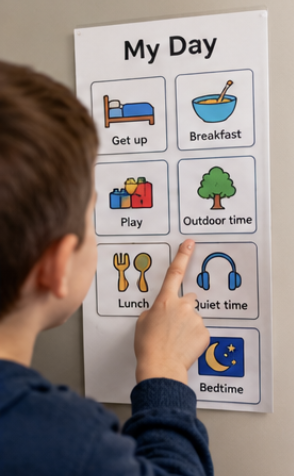
Instead, try creating a simple structure that gives your child an idea of what the day might look like. You could include familiar anchors such as breakfast, getting dressed, lunch, outdoor time and a relaxing evening activity.
Visual timetables can be particularly helpful. These might use photographs, pictures, symbols or written words, depending on what your child understands best.
The important thing is to make the routine easy to follow. You don't need to plan every minute of the day. Leaving room for spontaneous activities and downtime can help everyone feel less pressured.
Prepare for changes before they happen
If you're planning a trip, a family visit or an activity that is different from your usual routine, talk about it in advance.
Explain where you're going, who might be there, how long you expect to stay and what your child can do if they need a break. Photographs of the destination can help make an unfamiliar place feel more predictable.
Social stories or simple visual explanations may also help some children understand what to expect.
If plans need to change, try to explain this as early as possible. Acknowledging that something different is happening, rather than pretending nothing has changed, can help your child feel more prepared.
Don't underestimate the importance of downtime
It can be tempting to fill the holidays with exciting activities, particularly when you want your child to have a wonderful time.
But children who spend much of their school day managing sensory, social or emotional demands may need plenty of time to recharge.
A quiet afternoon, time spent enjoying a special interest or simply relaxing at home can be just as valuable as a busy day out.
Try not to feel guilty if your child wants to spend time doing something familiar. Repeating favourite activities can provide comfort and enjoyment.
Help with boredom and getting started
One of the difficulties some children experience during school holidays is knowing what to do with their free time.
You might find it helpful to create an activity menu. This could be a small collection of photographs or cards showing activities your child enjoys, such as drawing, building, gaming, baking or going outside.
When boredom strikes, your child can choose something from the menu rather than having to think of an activity from scratch.
For children with ADHD, breaking activities into smaller steps can also help. Instead of saying, "Go and tidy your bedroom", try explaining one manageable task at a time.
Look after sleep and mealtimes
Changes to sleep and mealtimes can affect how children feel throughout the day.
Although a little flexibility is part of the holidays, maintaining some familiar patterns can help. Try to keep bedtime and wake-up times reasonably consistent where possible, particularly if your child finds transitions difficult.
For children with sensory-related food preferences, familiar meals and snacks can also provide reassurance. Holidays are not necessarily the best time to introduce lots of unfamiliar foods or expectations around eating.
What if half term still feels difficult?
Even with the best preparation, there may be difficult days. Your child might become overwhelmed, struggle with a change of plan or find it hard to regulate their emotions.
Try to respond with curiosity rather than frustration. Think about what might be contributing to the situation and whether the environment, expectations or activity need adjusting.
If your child experiences a meltdown, prioritise safety, reduce demands and give them the time and space they need to recover. During periods of distress, lengthy explanations or repeated instructions can sometimes make things harder.
Give yourself permission to do things differently
There is no perfect way to organise a school holiday, and there is certainly no requirement to make every day exciting.
A successful half term might involve a few lovely outings, plenty of familiar routines and several afternoons doing very little at all.
The aim isn't to make your child fit into a particular idea of what a holiday should look like. It's to create an environment where they can feel comfortable, supported and able to enjoy their time away from school.
And sometimes, the best holiday plan is simply one that works for your family.