Air India Compensate Disabled Passenger
29 September 2026 · 6 min read
Air India Ordered to Compensate Disabled Passenger After ‘Fit-to-Fly’ Dispute
For disabled people who travel with wheelchairs, getting onto an aircraft often involves placing an enormous amount of trust in an airline. You have to trust that the assistance you requested will arrive, that staff understand your requirements and, perhaps most importantly, that the wheelchair giving you your independence will be waiting for you in the same condition when you land.
A case involving Air India and disabled passenger Falguni Maheshwari has put all three of those issues under scrutiny after India's Court of the Chief Commissioner for Persons with Disabilities imposed a £393 fine on the airline and recommended that it pay her nearly £4000 in compensation.
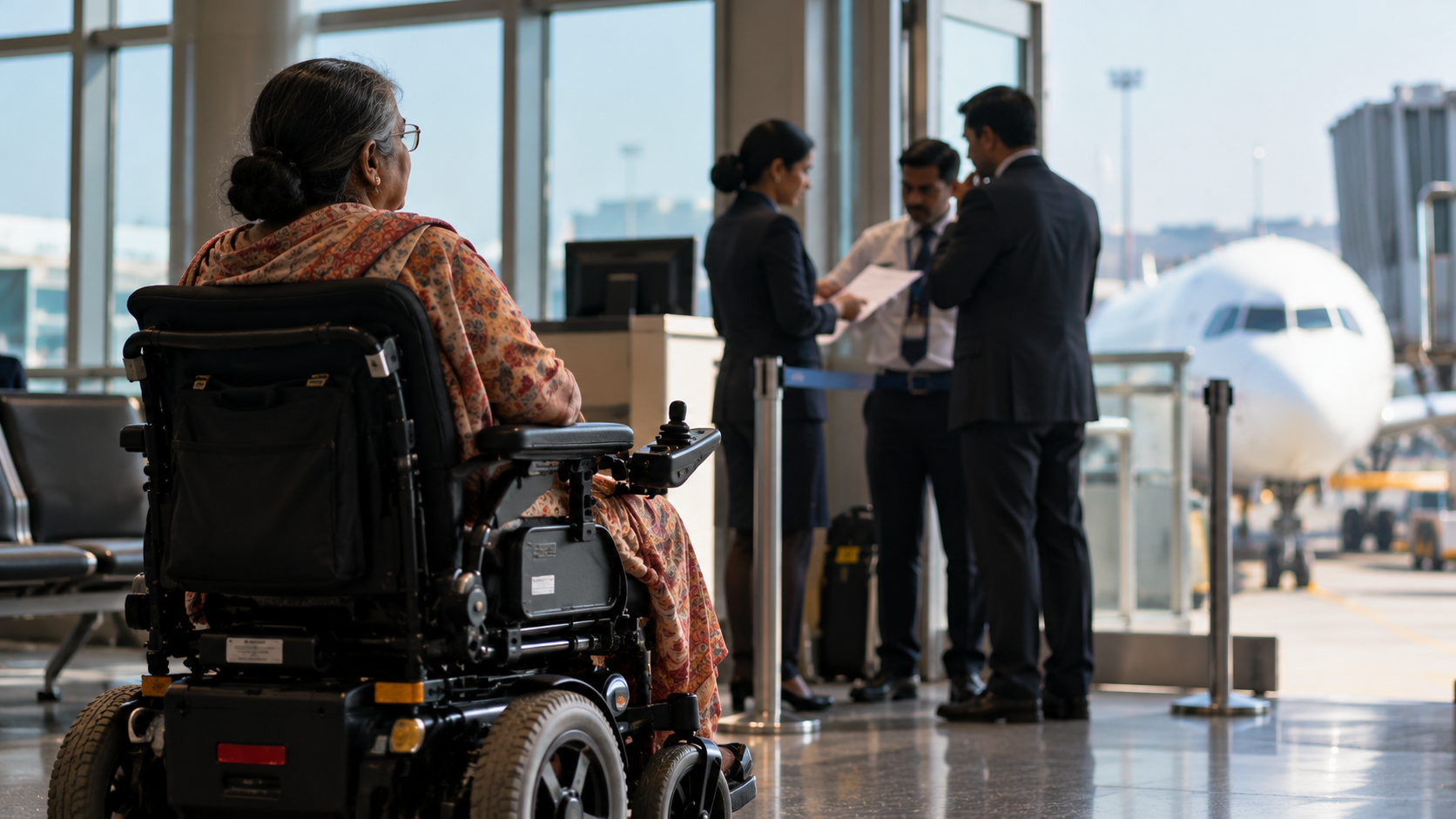
Maheshwari has an 80% locomotor disability and uses a powered wheelchair. According to the case records, she travelled with Air India from Frankfurt to Delhi on 26 May 2026 without facing a medical objection. The problem arose when she boarded her connecting flight from Delhi to Bhuj.
Maheshwari had already taken her seat when cabin crew began questioning whether she was fit to travel independently and requested a “Fit-to-Fly” certificate. She was subsequently removed from the aircraft.
That alone would be distressing. But the case became considerably more serious because Maheshwari said she wasn't medically examined by an airport doctor before being deboarded, wasn't provided with written reasons at the time and later alleged that her powered wheelchair had been returned to her damaged. She said she was forced to make alternative travel arrangements, adding expense and emotional distress to an already difficult situation.
Air India says the decision was about safety
There is an important other side to this case. Air India maintained that Maheshwari wasn't refused travel simply because she was disabled. The airline said cabin crew believed she appeared extremely tired and was suffering from a cough and cold, which raised concerns about whether she was medically fit to continue travelling.
Airlines obviously have a responsibility for passenger safety, and there will be circumstances where a genuine medical concern requires further assessment before somebody flies. Disability shouldn't mean that legitimate medical concerns have to be ignored.
The issue identified by the disability commissioner was what happened next.
According to reporting on the ruling, India's Directorate General of Civil Aviation found that where an airline believes a passenger's health may deteriorate during a flight, the applicable procedure requires an in-person medical assessment before refusing carriage, together with written reasons.
The commissioner found that Air India had not established that such an examination took place before Maheshwari was removed from the aircraft. The fact that she had already travelled on the Frankfurt-to-Delhi leg without a medical objection also formed part of the commissioner's consideration of the case.
Air India said Maheshwari subsequently obtained medical clearance and was accommodated on its next available flight without an additional fare. It also indicated that it was willing to repair or compensate her for the damaged wheelchair.
The commissioner nevertheless concluded that the way the situation had been handled justified further action.
A wheelchair isn't simply another piece of luggage
One of the most important parts of the ruling concerns Maheshwari's powered wheelchair.
When airlines damage a suitcase, it's frustrating. Clothes may need replacing and possessions may be lost. But when an airline damages somebody's wheelchair, the consequences can be completely different.
For many disabled people, a wheelchair isn't luggage that happens to travel in the aircraft hold. It's the equipment that allows them to move independently through the world.
The commissioner specifically recognised this distinction, describing assistive equipment as integral to a disabled person's mobility, independence and dignity. Damage to a wheelchair therefore cannot simply be viewed in the same way as damage to an ordinary suitcase.
This is particularly important with powered wheelchairs, which can be highly specialised and individually configured around the person using them. Repairs aren't always something that can be completed immediately at an airport, and replacing specialist equipment can be extremely expensive.
If a wheelchair is badly damaged, the person using it can effectively lose a significant part of their independence until it's repaired.
That's why wheelchair handling has become such an important issue in accessible aviation around the world. Getting the passenger safely from one airport to another isn't enough. Their mobility equipment needs to complete the journey safely too.
The case raises a bigger question about disability and medical assumptions
Perhaps the most significant part of Maheshwari's experience is the distinction between having a disability and being medically unfit to fly.
Those aren't the same thing.
A passenger can have significant mobility requirements and still be perfectly capable of travelling safely. Equally, a disabled or non-disabled passenger can experience a genuine medical problem that makes flying unsafe.
Airline staff therefore have to be able to recognise when a legitimate medical concern exists without automatically treating disability itself as evidence that somebody may not be fit to travel.
This is where proper procedures matter.
If staff have a genuine concern about someone's health, there needs to be an established medical assessment process rather than a decision based primarily on how somebody appears. That protects the airline, the crew and, most importantly, the passenger.
In Maheshwari's case, the commissioner concluded that Air India had failed to demonstrate that the required medical assessment happened before she was removed.
The ruling also recommended that Air India carry out an internal examination of the incident and ensure staff receive appropriate training around disability rights, reasonable accommodation, medical-clearance procedures, non-discrimination and the handling of assistive devices.
That may ultimately be one of the most important outcomes of the case.
Compensation addresses what happened to one passenger. Better procedures and training have the potential to prevent the same thing happening to somebody else.
The hidden cost is confidence
There is another consequence of incidents like this that is much harder to calculate.
Trust.
Disabled travellers often have to plan journeys much more carefully than other passengers. They may need to arrange airport assistance, confirm whether their wheelchair can be transported safely, provide battery information for powered equipment, plan transfers and make sure assistance is available at every connection.
Once everything has been arranged, they eventually have to trust the people providing the service.
A passenger shouldn't board an aircraft wondering whether a member of staff might unexpectedly decide they require additional medical documentation. They shouldn't have to worry about whether their wheelchair will survive the journey. And they shouldn't have to become an expert in aviation regulations simply to make sure they're treated correctly.
Every high-profile case where something goes wrong makes that trust slightly harder to maintain.
This doesn't mean airlines should never question whether somebody is medically fit to travel. Safety matters, and there will be legitimate situations where additional assessment is necessary. What matters is that those decisions are based on appropriate evidence, established procedures and proper medical judgement rather than assumptions about disability.
Accountability matters because the next passenger matters
The ruling in Maheshwari's case is therefore about more than ₹5 lakh compensation or a ₹50,000 fine.
It's about recognising the consequences when accessibility systems fail.
Maheshwari had already travelled internationally from Frankfurt to Delhi. She had boarded her connecting flight and taken her seat. She then found herself being questioned about her ability to travel, removed from the aircraft and, according to her complaint, reunited with a damaged powered wheelchair.
Air India says its actions were motivated by concerns for her safety. The disability commissioner nevertheless found significant problems with how the situation was handled and called for compensation, investigation and improved staff training.
Both parts of that story matter.
Airlines have a responsibility to keep passengers safe, but they also have a responsibility to make sure disability isn't confused with medical incapacity and that decisions affecting disabled passengers are made through proper procedures.
Perhaps most importantly, airlines need to understand that accessibility isn't simply about getting somebody onto an aircraft. It extends from booking and assistance through to communication, dignity and the safe handling of the equipment somebody relies upon for their independence.
When that equipment is a wheelchair, the airline isn't simply transporting somebody's possession.
It's transporting part of the way they move through the world.