New US airline accessibility rules take effect.
2 October 2026 · 4 min read
Flying with dignity: new US airline accessibility rules take effect today
For many wheelchair users, the most difficult part of flying does not begin at airport security or end at baggage reclaim. It can happen inside the aircraft itself, where a passenger who cannot walk independently may have to rely on a narrow onboard wheelchair simply to reach the toilet. From 2 October 2026, new US accessibility requirements begin changing how airlines must handle that experience.
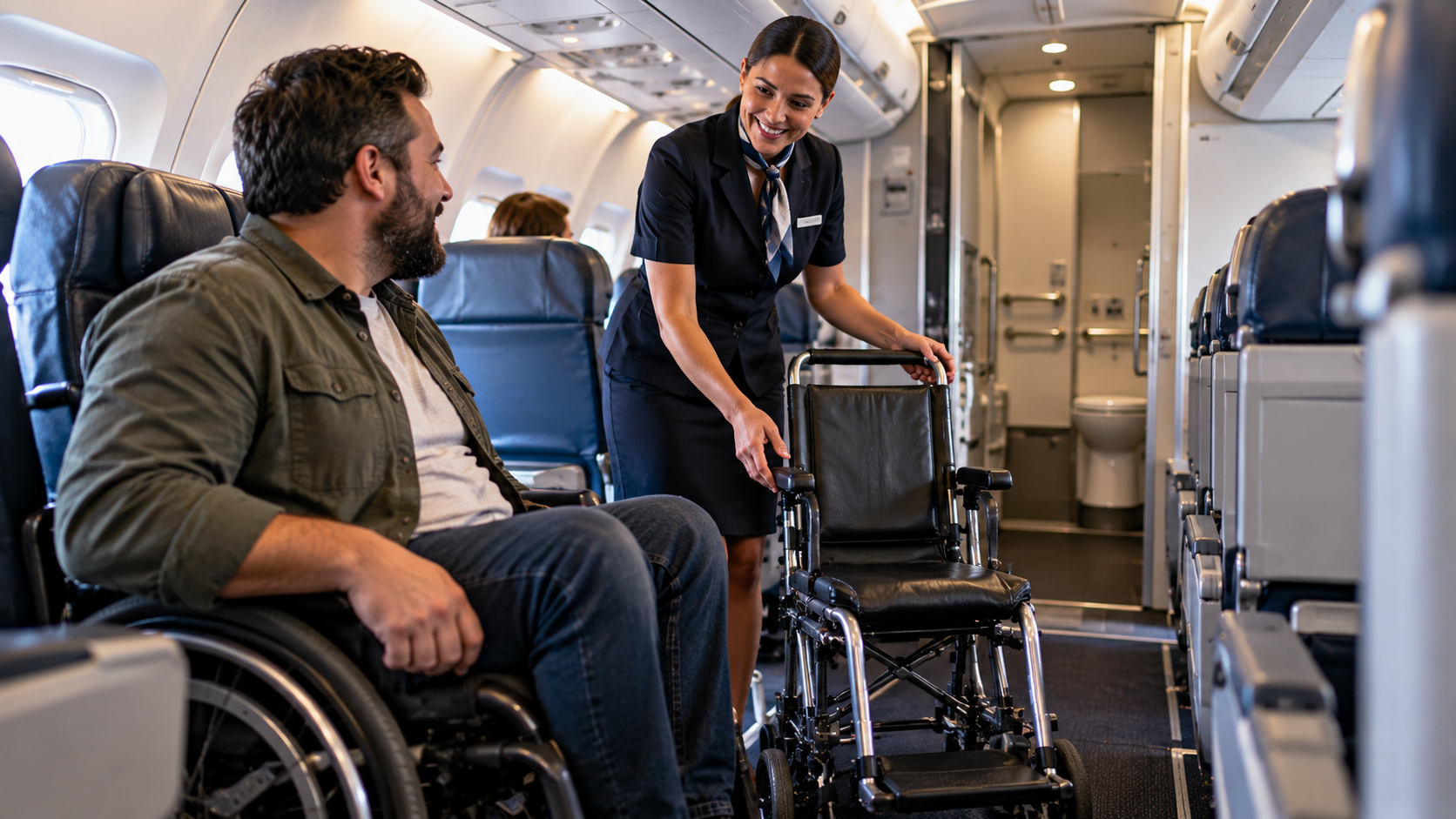
The rules are significant because they address an aspect of accessible air travel that is often invisible to passengers who do not need assistance. Onboard wheelchairs are specialised chairs designed to move through an aircraft's extremely narrow aisle. They can be essential for passengers who cannot walk between their seat and the lavatory, yet the design of aircraft cabins means using one can involve difficult transfers, limited support and a substantial loss of independence.
Under US Department of Transportation rules taking effect today, airlines operating aircraft with at least 60 seats must provide annual proficiency training for flight attendants on assisting disabled passengers to and from the lavatory. Crucially, that training is not supposed to be purely theoretical: it includes hands-on instruction covering the retrieval, assembly, stowage, transfer features and use of onboard wheelchairs, as well as the accessibility features of aircraft lavatories.
Passengers are also gaining clearer information rights. Airlines must provide information on request about relevant lavatory accessibility features, make that information available on their websites where they sell tickets to the public, and provide diagrams aboard aircraft showing features, controls and dispensers. The rules additionally require procedures covering disposal of sharps and bio-waste.
One particularly telling provision concerns the familiar International Symbol of Accessibility. Airlines must remove or conceal it from aircraft lavatories that do not allow a passenger to make an independent seated transfer from an onboard wheelchair to the toilet. In other words, a lavatory should no longer be visually presented as accessible when a wheelchair user cannot independently transfer into it.
That may sound like a small matter of signage, but it goes to the heart of accessible information. An accessibility symbol is effectively a promise. Disabled travellers make decisions around those promises, and inaccurate accessibility information can turn inconvenience into an intensely personal problem once an aircraft is thousands of metres in the air.
Another change begins affecting the chairs themselves. After 2 October, newly obtained onboard wheelchairs for aircraft with more than 60 passenger seats are subject to improved accessibility and safety standards, while replacement onboard wheelchairs on aircraft with 125 or more seats must also meet the applicable standards. The transition is deliberately gradual: the requirement for all onboard wheelchairs used on aircraft with more than 60 seats to meet the improved standards does not arrive until October 2031.
That distinction is important. Today's date does not mean every US flight suddenly has a newly designed wheelchair or a genuinely accessible toilet. Nor does it mean disabled passengers can now remain in their own wheelchairs during flight. Aircraft accessibility remains constrained by cabin design, and many single-aisle aircraft still present formidable barriers.
What has changed is the minimum expected standard around equipment, information and staff competence.
The wider context matters because wheelchair users have long faced problems that extend far beyond lavatories. Existing US passenger rights already require airlines to carry assistive devices without counting them against normal cabin-baggage limits, provide priority in-cabin stowage for qualifying manual wheelchairs on certain aircraft, return checked assistive devices promptly and compensate passengers when wheelchairs are lost, damaged or destroyed. Passengers who need additional time or assistance are also entitled to preboard.
Today's reforms therefore sit within a larger attempt to make air travel less dependent on luck: whether the right member of staff happens to be present, whether they have been adequately trained, or whether a passenger discovers only after boarding that an advertised accessible feature cannot actually meet their needs.
There will still be a gap between regulation and lived experience, and implementation will matter enormously. A rule requiring proficiency is valuable only if training translates into competent, respectful assistance on real flights. Improved onboard wheelchairs cannot solve inaccessible cabin architecture by themselves. And a phased implementation extending to 2031 means passengers will continue encountering different equipment on different aircraft for years.
But this is nevertheless meaningful progress. Being able to use a toilet safely on a journey lasting several hours is not a luxury, and neither is knowing in advance whether you can do so.
Accessible aviation is ultimately about more than getting a disabled passenger through an aircraft door. It is about whether that passenger can travel with the same basic dignity, information and confidence that other passengers take for granted.
Today, US aviation moves a little closer to that standard.