Changing the Way We See Disability
28 September 2026 · 6 min read
Adaptive Skateboarding Is Going Viral – And It’s Changing the Way We See Disability
There is something brilliant happening in skateparks at the moment.
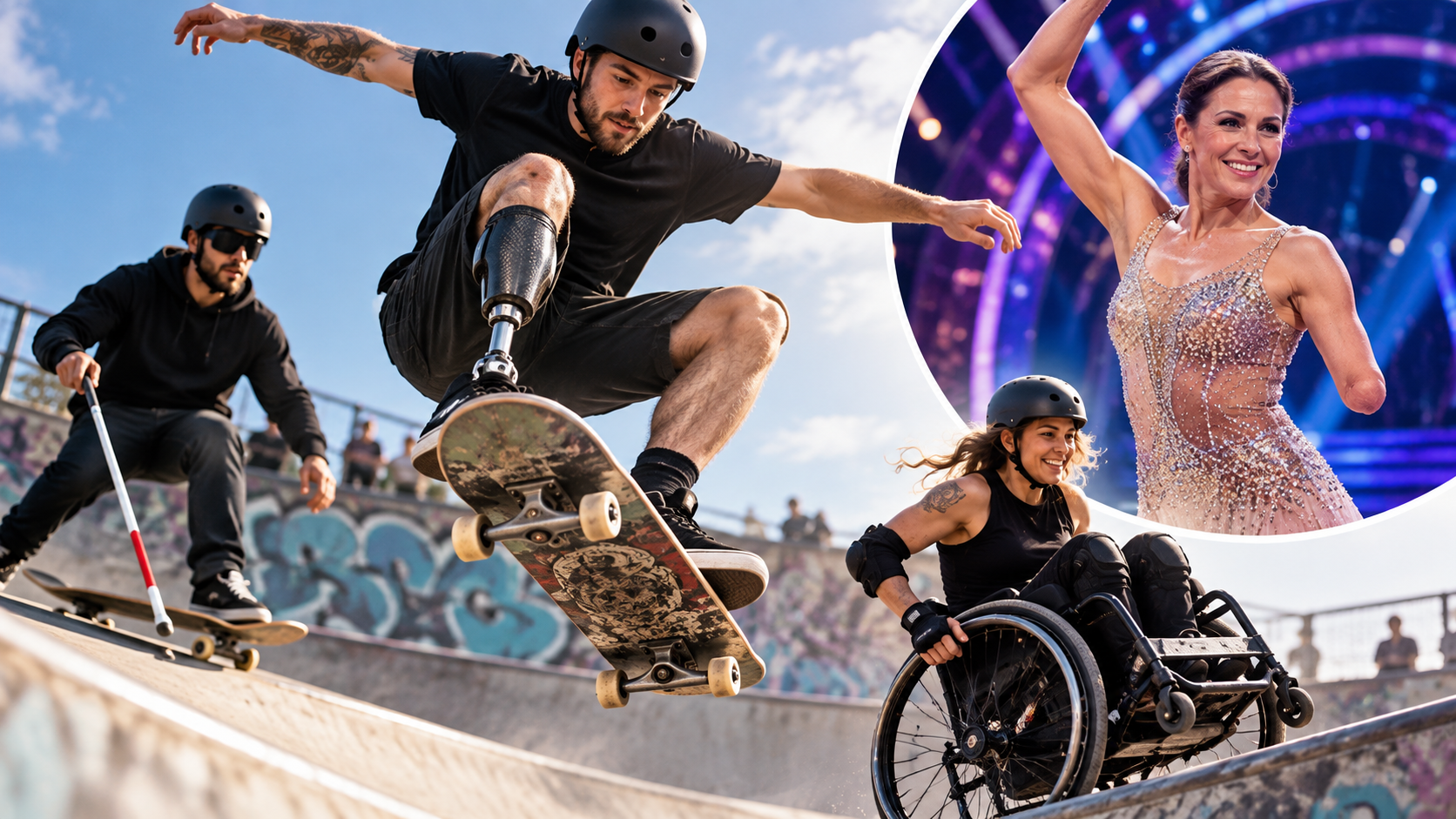
Videos of disabled skateboarders are reaching millions of people online, showing athletes with amputations, visual impairments and other disabilities dropping into ramps, landing tricks and competing alongside one another.
One of the videos attracting particular attention comes from Wheels for Wheels FrumpFest, an adaptive skateboarding event in Connecticut. Footage shared by blind athlete and skateboarder Anthony Ferraro has reportedly generated more than six million views across TikTok and Instagram.
But perhaps the most interesting thing about watching it is how quickly you stop thinking about disability.
You start watching the skating.
You notice the tricks. You see the falls. You see someone try again. You see the excitement when they land something difficult.
And underneath all of it is a simple message that goes far beyond skateboarding:
Sometimes you don't have to give up what you want to do. You just have to find a different way of doing it.
Skateboarding without sight
Anthony Ferraro was born blind because of Leber congenital amaurosis, but blindness hasn't prevented sport from becoming an enormous part of his life.
He's competed in judo, become involved in the Paralympic movement and built a huge online following by documenting everyday life as a blind person. He's also a skateboarder.
At first, that combination might sound almost impossible.
Skateboarding appears to be an incredibly visual sport. You need to know where the ramp begins, where an obstacle is positioned and where your board is going to land.
So how does somebody skateboard when they can't see those things?
They adapt.
Blind and visually impaired skateboarders can use sound, touch, memory and spatial awareness to understand a skatepark. Some adaptive environments use audible markers or contrasting surfaces, while repeated practice allows a skater to build a detailed mental understanding of where obstacles are positioned.
The skateboard hasn't suddenly become accessible because someone's disability disappeared.
The way they interact with it has changed.
And that distinction is important.
Prosthetics are opening up possibilities too
The same idea can be seen among amputee skateboarders.
One of the adaptive skating community's best-known figures is Oscar Loreto Jr., who was born without his left foot and left hand and with four fingers missing from his right hand.
Oscar learned to use prosthetics from an early age and eventually found his way into skateboarding.
Think about what that requires.
Balance is fundamental to skateboarding. Your feet control the board. Your ankles respond constantly to tiny movements underneath you. Your arms and upper body help control your balance.
When part of that system works differently, you have to learn a different system.
Modern prosthetics can play an enormous role in making that possible, but the technology is only part of the story.
The athlete still has to understand how their own body moves, how the prosthetic responds and how to alter techniques that were originally developed around a non-disabled body.
Eventually those adaptations stop being adaptations in the person's mind.
They simply become their way of skating.
And it isn't just skateboards
Adaptive sport is developing rapidly, and some of the equipment being used today is extraordinary.
Wheelchair users, for example, have developed WCMX – wheelchair motocross – where athletes use specially designed wheelchairs to tackle skateparks.
These aren't everyday wheelchairs being pushed down ramps.
They can incorporate suspension, reinforced frames, specialist wheels and other modifications designed to withstand the enormous forces involved in jumps and tricks.
The result is something that completely changes our perception of both the wheelchair and the skatepark.
A wheelchair is usually talked about as something that compensates for a limitation.
In WCMX, it becomes sports equipment.
That's a very different way of looking at disability.
And we're seeing exactly the same philosophy appear in another place millions of people wouldn't necessarily associate with adaptive sport:
the Strictly Come Dancing ballroom.
From the Paralympics to Strictly
This year's Strictly includes Dame Sarah Storey, Britain's most successful Paralympian.
Sarah was born without a functioning left hand and has spent decades adapting sporting technique around her body.
She began her Paralympic career as a swimmer before switching to cycling, ultimately collecting an extraordinary 30 Paralympic medals, including 19 golds.
Now she has taken on something completely different.
Dancing.
At first glance, cycling, swimming and ballroom dancing don't have much in common.
But perhaps they do.
Each requires Sarah to understand how her body moves and then find the technique that works for her.
She isn't walking onto the Strictly dancefloor pretending she doesn't have a disability.
She's learning how she dances.
And we've seen Strictly demonstrate this beautifully before.
Chris McCausland changed people's expectations
When blind comedian Chris McCausland joined Strictly Come Dancing in 2024, there was an obvious question.
How do you teach somebody choreography if they can't see the choreography?
Normally a professional dancer demonstrates a movement and their celebrity partner watches and copies it.
That wasn't going to work.
So Chris and his professional partner Dianne Buswell had to find another way.
Movements could be physically demonstrated. Positions could be described. Timing, touch, repetition and muscle memory could replace visual demonstrations.
The goal didn't change.
The teaching method did.
And Chris didn't simply make up the numbers in the competition.
He won it.
That was significant because millions of people watching at home saw something they might previously have assumed couldn't be done.
More importantly, blind and visually impaired people saw it too.
Representation like that matters.
If you've never seen somebody with your disability doing something, it's very easy to assume that activity simply isn't for people like you.
Disability doesn't always mean stopping
There is a tendency when someone becomes disabled – or when a child is born with a disability – to focus immediately on what they won't be able to do.
Sometimes those limitations are real.
Disability can affect mobility, energy, communication, balance, vision, hearing, dexterity and countless other parts of everyday life. We shouldn't pretend otherwise.
But it does mean we should be much more careful about assuming that different means impossible.
The environment has to adapt too
There's another important part of this story.
We can't place all the responsibility for adaptation on disabled people.
A wheelchair user can't practise their way up a staircase.
A blind person can't make an inaccessible website readable simply through determination.
The most exciting developments happen when both sides adapt.
The person finds their own technique, while equipment, environments, businesses, coaches and communities remove unnecessary barriers.
That's when possibilities really begin to open up.
And adaptive skateboarding is a fantastic example.
Somebody didn't look at a wheelchair and a skatepark and decide the two didn't belong together.
They asked how they could make them work together.
That way of thinking can be applied almost everywhere.
Adapt the method, not automatically the ambition
Perhaps that's the biggest lesson from adaptive sport.
When something doesn't work, our first reaction shouldn't always be to lower the ambition.
Sometimes we need to change the method.
If you can't do something the conventional way, perhaps there is another way.
That's how progress happens.
The technology available to disabled people is improving. Prosthetics are becoming more advanced. Wheelchairs are becoming more specialised. Accessible sports programmes are growing. Coaches are learning different techniques.
But perhaps most importantly, attitudes are beginning to change.
We're slowly moving away from asking:
“Why can't this person do this?”
and towards asking:
“What would make it possible?”
That's a much better question.
A disability may change the way you do something. It doesn't automatically mean you have to stop doing it.
Sometimes you just need to find your way.