Major Changes to Disability Benefits

Published · 14 min read
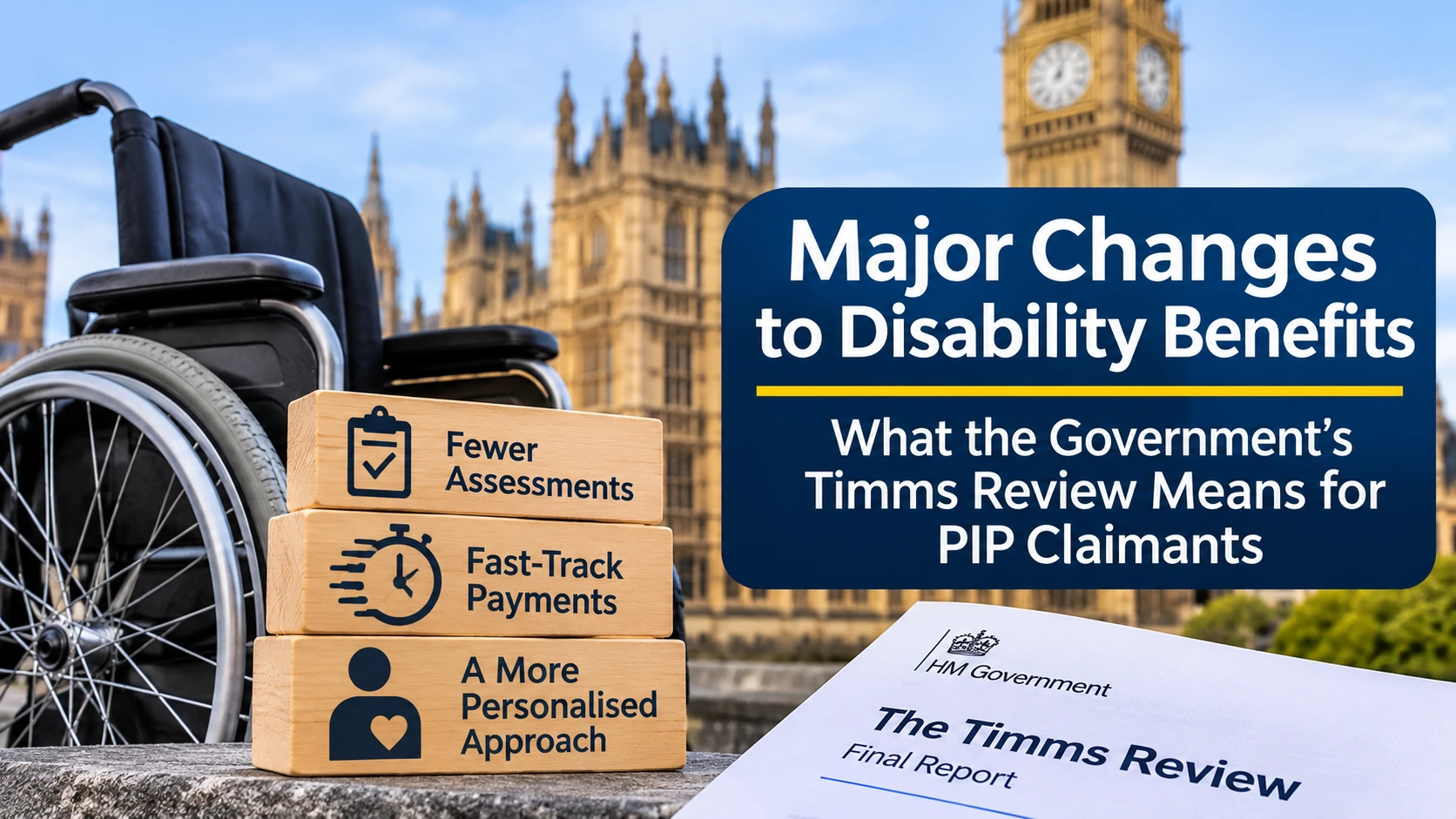
What the Government's Timms Review Means for PIP Claimants
The Government has announced a significant overhaul of the Personal Independence Payment (PIP) system, following the publication of the long-awaited Timms Review on 24 November 2026. The review represents the first comprehensive examination of PIP since the benefit was introduced 13 years ago and could mark a substantial change in how disability-related support is assessed, awarded and delivered across England and Wales.
For disabled people, those living with long-term health conditions and their families, the announcement brings some potentially positive developments. The Government has committed to reducing unnecessary reassessments for people with lifelong or progressive conditions and introducing a fast-track route for people with severe, well-evidenced medical conditions. However, the wider proposals go considerably further, raising important questions about how future assessments will operate, how individual needs will be measured and whether the proposed reforms will provide sufficient protection for those who rely on disability benefits to meet essential living costs.
It is important to distinguish between the changes the Government has committed to and the recommendations that are still being considered. Although two measures have received immediate government backing, the wider overhaul has not yet been implemented. The Government intends to publish its formal response ahead of a White Paper in early 2027, with further legislative proposals expected to follow.
Why is the Government changing the PIP system?
The Timms Review was established to examine whether the existing PIP system adequately reflects the realities of living with a disability or long-term health condition. Its findings suggest that, although PIP remains an important source of financial support, the assessment process and the way individual needs are recognised require substantial improvement.
PIP is designed to help people meet the additional costs associated with disability, including mobility, personal care, accessing services and managing everyday activities. It is not means-tested and is available to eligible people whether they are in employment or unable to work.
However, concerns have continued to emerge around the assessment process, particularly the difficulties faced by people whose conditions fluctuate, those with multiple health conditions and individuals who are repeatedly required to provide evidence of disabilities that are unlikely to improve.
The scale of the issue is reflected in the evidence gathered during the review. More than 40,000 disabled people, people with long-term health conditions and organisations contributed to the process. Of those responding to the review's call for evidence about the assessment process, more than 90% described their experiences negatively, using terms including stressful, dehumanising and psychologically damaging.
These findings are particularly significant because they demonstrate that dissatisfaction is not simply about the financial value of PIP. For many claimants, the process of obtaining and retaining their entitlement has become a considerable source of anxiety and uncertainty.
The wider financial context is also important. Research published by the Institute for Fiscal Studies (IFS) found that the proportion of working-age people in England and Wales receiving PIP or its predecessor benefit increased from 5.5% in August 2019 to 8.2% in August 2025. Disability benefit expenditure rose from approximately £14 billion in 2019–20 to £25 billion in 2025–26, with spending forecast to reach £33 billion by 2030–31.
These figures help explain why the Government is examining the long-term sustainability of the system. However, rising expenditure should not automatically be interpreted as evidence that people are receiving support they do not need. Population changes, increased recognition of health conditions, changing levels of disability and the growing complexity of individual needs must all be considered.
Source: Institute for Fiscal Studies – What to expect from the Timms Review.
Two changes the Government has agreed to introduce
The most immediate outcome of the review is the Government's acceptance of two recommendations intended to improve the experience of people with the most significant or permanent health conditions.
Fewer unnecessary reassessments for people with lifelong conditions
One of the most important commitments concerns people with lifelong, progressive or degenerative conditions.
Under the current system, claimants may be required to undergo further award reviews even when their medical circumstances are unlikely to improve. This can mean completing paperwork, obtaining supporting evidence and potentially attending another assessment, despite there being little realistic prospect of a change in their condition or support requirements.
The Government has committed to reducing unnecessary reviews where there is clear evidence that a person's needs are unlikely to change or are likely to deteriorate.
For claimants, this could provide considerably greater financial security and reduce the administrative and emotional burden associated with repeatedly having to demonstrate their disability.
It is also a recognition that the assessment process should be proportionate. Someone living with a permanent, degenerative condition should not routinely be expected to start again from the beginning simply to establish circumstances that have already been extensively documented.
The review also recommends that future reviews should build upon the information already held by the DWP, concentrating on what has changed rather than requiring claimants to repeat their entire medical history.
This is a welcome development. However, the practical effectiveness of this commitment will depend on how the Government defines qualifying conditions, what evidence it requires and how consistently the new approach is applied. Until detailed implementation guidance is published, claimants should not assume that all future reviews have automatically been cancelled.
A new fast-track route for people with severe medical conditions
The second commitment is the introduction of a fast-track route for people with severe, well-evidenced medical conditions.
This is intended to reduce unnecessary delays and the assessment burden for people whose circumstances can be clearly established through existing medical evidence. It will operate alongside the existing arrangements for people nearing the end of life.
For individuals with severe disabilities or significant health conditions, lengthy assessment processes can create additional stress at a time when they may already be dealing with considerable medical, financial and personal difficulties.
A faster route could mean earlier access to financial support and fewer unnecessary assessment appointments. It may also help ensure that people in particularly vulnerable circumstances are not left waiting for decisions that could have been reached more efficiently.
Nevertheless, there are questions that remain unanswered. The Government has not yet set out the complete eligibility criteria, the evidence requirements or the precise timescales for processing applications through this route.
It will be particularly important to ensure that the definition of severe conditions does not become too restrictive. Some people experience substantial disability and additional costs without having a condition that is immediately identifiable as severe through a straightforward medical diagnosis.
A fundamental change to how disability is assessed
Beyond the two immediate commitments, the Timms Review recommends a more fundamental redesign of the PIP system.
One of its central arguments is that the current assessment places too much emphasis on what a person cannot do, rather than examining the barriers they experience, the additional costs they face and the support required to live independently.
The proposed approach would place greater emphasis on a person's individual circumstances, including the practical consequences of their condition and the impact it has on their ability to participate in everyday life.
This could represent a significant improvement for people whose disabilities do not fit neatly into the existing assessment framework.
For example, someone with a fluctuating condition may be capable of completing certain activities on a good day but experience substantial difficulties on other days. An assessment that focuses too narrowly on whether an activity can be completed may fail to capture the consistency, reliability and support required to manage everyday life.
The review recognises that disability is not always straightforward or consistent. People with conditions such as multiple sclerosis, chronic fatigue, fibromyalgia and certain mental health conditions can experience substantial variations in their symptoms and functional abilities.
A more personalised assessment could help ensure that these experiences are properly recognised.
However, changing the assessment approach also introduces a significant challenge. The Government will need to establish clear and consistent criteria so that decisions remain fair, evidence-based and transparent. Greater personalisation should not result in uncertainty about entitlement or inconsistent decisions between assessors.
Better recognition of fluctuating conditions and multiple disabilities
Another important area addressed by the review is the way the current system assesses people with fluctuating conditions and multiple health problems.
For many claimants, the impact of disability cannot be understood by considering individual conditions in isolation. Someone may experience chronic pain, fatigue, mobility difficulties and mental health problems simultaneously, with each condition affecting the others.
The DWP's supplementary evidence highlights this complexity. Since October 2024, approximately four out of five successful assessment-provider clearances recorded more than one associated health-condition group. This suggests that multiple and overlapping conditions are a significant feature of successful PIP claims.
The review recommends improving the way these circumstances are considered, including providing better opportunities for claimants to explain how their conditions affect them over time.
This is particularly important because the ability to perform an activity occasionally does not necessarily mean that someone can manage it safely, repeatedly or reliably.
If implemented effectively, these changes could result in a fairer assessment for people whose difficulties are not always visible during a single appointment.
The challenge will be ensuring that assessors have sufficient training, time and appropriate medical information to understand the cumulative impact of multiple conditions.
Source: DWP – Supplementary Evidence Pack for the Timms Review.
Could PIP become a different type of benefit?
Perhaps one of the most significant longer-term recommendations is the proposal to create a reformed benefit that retains the financial support people value about PIP while offering additional, more personalised services.
The review recommends retaining cash payments as the foundation of the system. However, it also suggests that claimants could be offered additional support, including access to health and social care services, employment assistance, education opportunities and peer support.
There is also a proposal for voluntary arrangements through which individuals could choose to exchange part of their cash award for a particular service.
The emphasis on choice is important. Disability-related costs vary considerably between individuals. One person may need additional transport, while another may face higher heating costs, specialist equipment expenses or the need for additional personal support.
A system that recognises these differences could provide more relevant assistance than one relying exclusively on standardised assessment outcomes.
However, it is essential that additional services complement rather than undermine financial independence.
Cash payments allow people to decide how best to manage their own circumstances. A service that appears beneficial in theory may not be accessible, suitable or available locally. It would therefore be important that any voluntary arrangements genuinely remain voluntary and that individuals retain meaningful control over their support.
The review also proposes a personalised digital profile, following a 'Tell Us Once' approach. This would aim to prevent people from repeatedly providing the same information to different parts of the system.
Such an approach could significantly reduce administrative duplication, although suitable telephone, paper and face-to-face alternatives would remain essential for people who cannot access digital services.
What do the statistics tell us about the existing system?
The evidence published alongside the review provides some important context about why reform is being considered.
For example, the DWP's analysis found that approximately 75% of planned PIP award reviews resulted in an unchanged award in the financial year ending 2026. This compares with 40% in the financial year ending 2018.
In other words, a growing proportion of planned reviews are confirming that the claimant's existing award remains appropriate.
This does not mean that reviews serve no purpose. They remain important for identifying changes in individual circumstances and ensuring that people receive the correct level of support. However, the figures raise a reasonable question about whether repeated reviews are always proportionate, particularly where a condition is permanent or progressive.
The review also found that around two-thirds of current PIP awards are expected to undergo a future review. This illustrates the potential scale of the administrative burden for both claimants and the DWP.
There is also evidence of a considerable shift in assessment methods. Since the pandemic, telephone assessments have accounted for approximately 70% to 85% of monthly new-claim assessments, compared with around 5% to 10% conducted face to face.
The review recommends greater flexibility in assessment methods, including increased capacity for face-to-face appointments where appropriate.
These statistics highlight an important point: improving the PIP system is not simply about changing eligibility rules. It is also about making the assessment process more efficient, proportionate and responsive to individual needs.
Source: DWP – Timms Review Supplementary Evidence Pack.
The positive aspects of the proposed reforms
There are several encouraging elements within the review, particularly for people who have experienced difficulties with the current system.
Reducing unnecessary reassessments is arguably one of the most welcome commitments. People with permanent and degenerative conditions should not have to repeatedly demonstrate circumstances that are unlikely to change. Providing greater stability could reduce anxiety and allow individuals to concentrate on managing their health and everyday lives.
The proposed fast-track route is another positive step, particularly for people with severe medical conditions who may otherwise face lengthy and stressful assessment processes.
There is also considerable potential in the recommendation to improve the recognition of fluctuating conditions. Many disabilities are complex, and an assessment should reflect the reality of someone's everyday life rather than relying on a narrow snapshot of their abilities.
The proposals to simplify application forms, improve communication and provide better access to advocacy support are also welcome. For people who struggle with paperwork, communication or explaining their medical circumstances, these changes could make the process considerably more accessible.
Perhaps most importantly, the review has been developed with substantial involvement from disabled people themselves. More than 40,000 people and organisations contributed to the process, providing an important opportunity for lived experience to influence future policy.
What has not yet been addressed?
Despite the positive elements, there are still significant questions that the Government needs to answer.
One of the biggest concerns is whether the proposed reforms will genuinely protect existing claimants from financial uncertainty.
Although the Government has committed to reducing unnecessary reassessments and introducing a fast-track route, it has not yet provided a complete explanation of how existing awards will be treated under a redesigned system.
There is also uncertainty around the future assessment criteria. The review proposes moving towards a more personalised understanding of disability-related costs and individual needs, but the Government has not yet explained precisely how these will be measured or how award levels will be determined.
This matters because people rely on PIP to meet essential costs. Any future assessment framework must avoid creating situations where individuals lose financial support simply because their circumstances are difficult to quantify.
Another issue is the availability of additional services. Offering access to health, social care and employment support may be beneficial, but these services are already subject to significant pressures in many areas. A referral is of limited value if the service itself is unavailable or has an extensive waiting list.
The Government must also ensure that people with less visible disabilities, mental health conditions and fluctuating illnesses are not disadvantaged by any new assessment model.
There is a further question around the relationship between PIP and other disability-related benefits. The Timms Review focuses primarily on PIP. It does not, by itself, finalise changes to Universal Credit's health-related element or Employment and Support Allowance. Those issues are part of wider welfare reform discussions, including the separate Milburn Review.
For people receiving more than one form of disability-related support, it will be important to understand how any future changes interact and whether they create unintended consequences.
Finally, there is the question of implementation. A well-intentioned policy will only deliver meaningful improvements if the DWP has sufficient resources, appropriately trained assessors and clear guidance to apply it consistently.
What does this mean for people currently receiving PIP?
For existing claimants, the most important message is that today's announcement does not mean that everyone's PIP award is changing.
The Government has not announced an immediate general reduction in PIP payments, nor has it confirmed that existing claimants will all have to undergo reassessment under new rules.
The two accepted commitments are intended to improve the position of people with severe, lifelong or progressive conditions. However, the practical arrangements and implementation dates still need to be established.
People who currently receive PIP should continue to follow their existing award conditions and respond to any official correspondence from the DWP. There is no reason to assume that an existing award has automatically been withdrawn or changed as a result of the review.
It is equally important that people do not make decisions about employment, finances or future claims based on proposals that have not yet been implemented. PIP remains available to eligible people who work as well as those who do not.
What happens next?
The publication of the Timms Review is an important step, but it is the beginning of a further period of policy development rather than the completion of the reforms.
The Government will consider the recommendations alongside the Milburn Review of young people and work. It intends to publish its response in the coming weeks, ahead of a White Paper in early 2027.
That response should provide greater clarity about which recommendations the Government intends to adopt, how the future assessment system will operate and what legislative changes may be required.
Until those details are published, it would be premature to assume that all the proposed changes will be introduced in their current form.
A welcome step, but important questions remain
The Timms Review represents a significant opportunity to improve a system that many disabled people have found difficult, stressful and unnecessarily complicated.
The commitments to reduce unnecessary reassessments and introduce a fast-track route are positive developments. The wider proposals also offer the possibility of a more personalised and accessible system that recognises the real-life impact of disability rather than focusing exclusively on what someone can or cannot do.
However, the success of these reforms will ultimately depend on how they are implemented. Greater personalisation must not come at the expense of financial security, and additional services must not become a substitute for the independence that cash benefits provide.
For the thousands of people who depend on PIP to meet the additional costs of living with a disability, the priority must remain clear: a system that is fair, consistent, accessible and capable of recognising the full impact of their individual circumstances.
The Government has acknowledged that the existing system needs to change. The next challenge is ensuring that those changes deliver meaningful improvements for the people who rely on it.
Further information and sources
The following official publications and independent research provide further detail about the review, its findings and the statistics referenced in this article.
- Department for Work and Pensions: Timms Review recommends overhaul of disability benefits system – 24 November 2026.
- Department for Work and Pensions: Timms Review of Personal Independence Payment – What you need to know.
- Department for Work and Pensions: Supplementary Evidence Pack – The Timms Review Final Report.
- Institute for Fiscal Studies: What to expect from the Timms Review.
- Institute for Fiscal Studies: Options for reforming Personal Independence Payment.