The Clocks Are Going Back!

Published · 11 min read

A Helpful Guide for SEND Families to Navigate the Time Change and Changing Seasons
As October draws to a close, there's another seasonal change just around the corner. The clocks are going back tonight, Sunday 25 October, giving us an extra hour in bed and officially welcoming the darker evenings and shorter days.
For some families, this is a welcome opportunity to enjoy a slower start to the morning. But for families with autistic children, children with ADHD and those with other additional needs and disabilities, the clocks changing can bring a few unexpected challenges.
A change of just one hour might not sound like much, but when your child relies on familiar routines, predictable timings and consistency, even a small adjustment can have a knock-on effect. Bedtimes, wake-up times, mealtimes, school routines and daily activities can all feel a little different.
And it's not just the clocks that are changing. The arrival of autumn and winter means colder mornings, darker afternoons, wetter weather and a need to start thinking about different clothing. For children who have sensory sensitivities or who are particularly attached to familiar clothes, this can be another adjustment to navigate.
So, how can you make the transition a little easier?
The good news is that a bit of preparation, patience and flexibility can go a long way. Here are some practical ideas to help your family navigate the clock change and the changing seasons.
Why can the clocks changing be difficult for children with additional needs?
For many autistic children, routine and predictability are incredibly important. Knowing what happens next, when they will eat, when they will go to bed and what their day will look like can provide a real sense of security.
The clocks going back can temporarily disrupt that familiar pattern.
Your child might still feel ready for bed at what was previously their normal bedtime, even though the clock now says something different. Equally, they might wake up earlier than expected because their body clock hasn't adjusted to the new time.
Children with ADHD may also find the transition challenging. Changes to sleep patterns can affect concentration, emotional regulation and the ability to manage everyday demands. If your child already struggles with getting up, getting dressed or moving between activities, a change in routine can add another layer of difficulty.
It's worth remembering that every child is different. Some won't notice the change at all, while others might need several days or longer to settle into a new pattern. There is no need to expect everything to fall into place immediately.
1. Start adjusting bedtime gradually
One of the simplest ways to make the clock change easier is to avoid expecting your child to adapt overnight.
If you know your child struggles with changes to their routine, you could gradually adjust their bedtime in the days surrounding the clock change.
For example, moving bedtime in small increments of around 10 to 15 minutes can help make the transition feel less sudden. You can use the same approach with wake-up times and mealtimes if necessary.
If you haven't had the opportunity to prepare in advance, don't panic. You haven't missed your chance. Simply give your child a little time to adjust over the coming days.
Try to keep the familiar parts of your bedtime routine exactly the same. If your child usually has a bath, puts on their favourite pyjamas, reads a story and then goes to bed, maintain that sequence even if the clock now shows a different time.
The familiar routine can provide reassurance while the timings gradually settle.
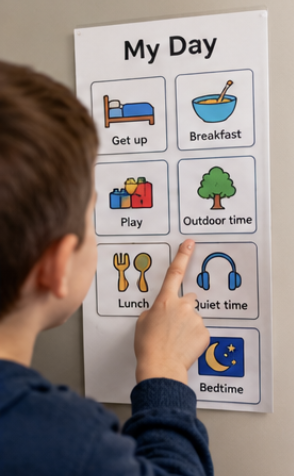
2. Use visual timetables to explain the change
For children who benefit from visual communication, a simple visual timetable can help explain what's happening.
You could create a little sequence showing that the clocks are changing, followed by breakfast, getting dressed, playtime, lunch and bedtime.
Some children might benefit from seeing a picture of a clock with the hands moving backwards, while others may find a simple explanation more useful.
You could say something like, "The clocks are changing tonight. When you wake up tomorrow, the clock will show a different time, but we'll still have breakfast, get dressed and do our usual things."
For children who find unexpected changes difficult, reassurance that the important parts of their day are staying the same can be particularly helpful.
You could also use a countdown calendar or a simple social story in the days leading up to the change.
3. Make mornings as predictable as possible
One of the challenges families sometimes experience after the clocks go back is an earlier start to the day.
Your child might wake up at what feels like their usual time, but the clock will show an hour earlier.
If your child is an early riser, this could mean some particularly early mornings for a little while!
Try to keep mornings calm and predictable. Have familiar breakfast options available, keep the usual order of activities and avoid introducing lots of new expectations at once.
If your child uses a visual morning routine, update it if necessary so that the new timings are clear.
For children who use a suitable visual clock or sleep-training clock, you may also find it helpful to adjust the settings so that the colours or symbols match the new schedule.
4. Think about lighting and the darker evenings
One of the biggest differences families notice as we move towards winter is just how much earlier it gets dark.
For some children, this can affect their mood, energy levels and willingness to go outside. Others might find the darker mornings confusing or unsettling.
Try to make the most of natural daylight whenever possible. A short morning walk, some time in the garden or simply opening the curtains and spending time near a window can help establish a familiar daytime routine.
As the evenings become darker, think about the lighting in your home.
Some children are sensitive to bright overhead lights, while others prefer a well-lit environment. Consider what makes your child feel comfortable and introduce changes gradually.
You could also use familiar evening activities to signal that bedtime is approaching. Reading, listening to music, having a warm bath or enjoying a favourite quiet activity can help create a reassuring transition from daytime to night-time.
5. Getting used to warmer clothes: why this can be a bigger challenge than you think
Now let's talk about something that can be particularly challenging for many autistic children: clothing.
As the weather gets colder, we naturally start reaching for jumpers, coats, thicker socks, leggings and warmer layers. We might think nothing of swapping a T-shirt for a sweatshirt or adding a coat before leaving the house.
But for a child who has become very comfortable wearing the same clothes repeatedly, this change can feel enormous.
Some autistic children have strong preferences for particular fabrics, textures, fits and styles. They might have a favourite T-shirt that they want to wear every day, a particular pair of trousers that feels just right or a specific type of socks that they find comfortable.
These preferences are not necessarily about being difficult or refusing to cooperate. Clothing can create a very real sensory experience, and a change in fabric, temperature, seams or fit can feel uncomfortable or even distressing.
When the weather changes, families can suddenly find themselves facing a wardrobe full of clothes their child doesn't want to wear.
So, how can you make the transition easier?
6. Introduce winter clothing gradually
Rather than suddenly replacing summer clothes with winter clothing, try introducing new items one at a time.
If your child has a favourite T-shirt, see whether you can find a similar version in a thicker fabric or a long-sleeved style.
If they love wearing a particular pair of leggings or trousers, look for another pair with a similar fit, waistband and material.
The aim is to find something that feels familiar rather than introducing a completely different experience.
You could start by wearing a warmer item for a short period at home, when there is no pressure to leave the house. This gives your child an opportunity to explore how it feels without the added demands of getting ready for school or going out.
Don't insist that they wear something for hours if they're clearly uncomfortable. Allowing them time to become familiar with an item can be much more effective than turning getting dressed into a daily battle.
7. Keep familiar clothes and introduce layers
For some children, the easiest solution is to keep wearing familiar clothes and add warmer layers where possible.
For example, if your child is comfortable wearing a particular T-shirt, they might be happy to wear it underneath a familiar cardigan, fleece or jacket.
Layers can be useful because they allow you to adapt to changing temperatures without replacing the clothing your child already feels comfortable in.
However, it's important to remember that layers aren't suitable for everyone. Some children dislike the feeling of multiple items of clothing, tight sleeves or fabric sitting against their skin.
Experiment with different options and let your child have a say in what feels comfortable.
You might also find that a familiar hoodie, soft blanket scarf or preferred coat becomes an important part of their winter wardrobe.
8. Prepare for coats, hats and gloves
Coats, hats, scarves and gloves can introduce a whole new collection of sensory challenges.
A coat might feel too heavy, a hat might be itchy, gloves might make it difficult to use their hands and scarves might feel restrictive around the neck.
Instead of buying an entire winter wardrobe in one go, start by identifying what your child is most comfortable wearing.
If they dislike traditional woolly hats, perhaps a soft cotton hat or fleece-lined alternative might work better.
If gloves are a problem, you could explore different styles and materials, or look at mittens if your child finds them easier to tolerate.
Some children prefer coats with familiar fastenings, while others find zips, buttons or tight cuffs uncomfortable.
If possible, let your child try things on before you buy them. A little time spent finding the right texture and fit can save considerable frustration later.
9. Use photographs and choices to make getting dressed easier
For children who benefit from visual support, creating a simple autumn and winter clothing board can be really helpful.
You could take photographs of your child's preferred clothes and use them to create a selection of suitable outfits.
Rather than asking an open-ended question such as, "What do you want to wear today?", offer two or three choices that are appropriate for the weather.
For example, you might show them two familiar tops and ask which one they'd prefer.
This gives your child a sense of control while keeping the decision manageable.
You could also create a simple visual reminder showing what to wear when it's cold, wet or windy.
If your child understands photographs better than symbols, use pictures of their actual clothing rather than generic images.
10. Don't forget shoes, socks and wet-weather clothing
Autumn and winter bring muddy paths, wet playgrounds, puddles and colder feet.
For children with sensory sensitivities, changing from lightweight summer footwear to heavier shoes or boots can be another difficult transition.
Some children dislike the feeling of thicker socks, while others find waterproof fabrics uncomfortable.
Try to think ahead and identify suitable options before the weather becomes particularly cold.
If your child has a favourite style of shoe, look for a warmer or more weather-appropriate version with a similar shape and fit.
You might also keep a spare familiar pair of socks and comfortable clothing in their school bag in case they get wet.
For children who find wet clothing particularly distressing, having a predictable plan for changing into dry clothes can be reassuring.
11. Make outdoor activities part of the new routine
Although darker evenings and colder weather can make it tempting to stay indoors, spending time outside can still be beneficial.
Autumn offers lots of wonderful opportunities to explore the changing environment.
You could go on a woodland walk, collect colourful leaves, look for conkers, jump in puddles or simply enjoy a little fresh air.
For children who enjoy familiar routines, returning to the same park or walking route can make outdoor activities feel more predictable.
If your child finds the cold uncomfortable, start with short outings and build up gradually. There is no need to spend hours outside.
Think about the sensory experience too. The crunch of leaves, the sound of rain, the feeling of cold air and the smell of autumn can all be interesting, but they may also be overwhelming for some children.
Follow your child's lead and adapt the experience accordingly.
12. Be patient if your child takes longer to adjust
Perhaps the most important advice is to give everyone a little breathing space.
The clocks changing, the weather becoming colder, different clothes, darker mornings and altered school routines can all happen within a relatively short period.
For a child who finds change difficult, that can be a lot to process.
You might notice more frustration, difficulties with sleep, reluctance to get dressed or a greater need for familiar activities.
Try to look at the bigger picture rather than treating each difficulty as a separate behaviour problem.
Could your child be tired? Are they uncomfortable in their clothing? Have they had less time outside? Is the change in daylight affecting their routine?
Sometimes making one small adjustment can improve several things at once.
And remember, there is no need to introduce every seasonal change immediately. You can take things one step at a time.
A little reminder for parents and carers
As parents and carers, we often put a lot of pressure on ourselves to make sure everything runs smoothly.
We want our children to sleep well, get dressed without difficulty, enjoy school and embrace the changing seasons.
But family life with additional needs doesn't always work to a neat timetable, and that's okay.
If your child needs a little longer to adjust to the clocks changing, that's okay. If they want to wear their favourite T-shirt underneath a warm jumper every day, that's okay too. And if your idea of a successful autumn weekend is staying cosy at home with familiar activities, there's absolutely nothing wrong with that.
The important thing is to understand what makes your child feel comfortable, make changes at a manageable pace and give them the support they need.
The clocks might be going back, the evenings might be getting darker and the winter coats might be coming out, but familiar routines, patience and a little flexibility can help make the transition much easier.
Here's to a cosy, comfortable and happy autumn and winter for the whole family.