New Sensory Room at Manchester Airport
2 October 2026 · 6 min read
For many families, arriving at the airport is when the excitement of a holiday really begins. But for a child or adult with special educational needs and disabilities (SEND), autism or sensory processing differences, the airport environment can present significant challenges.
Crowds. Queues. Announcements. Bright lighting. Security checks. Unfamiliar smells. Changes to routine. And the uncertainty of when you will actually board the aircraft.
That is why a new development at Manchester Airport's Terminal 2 is particularly welcome.
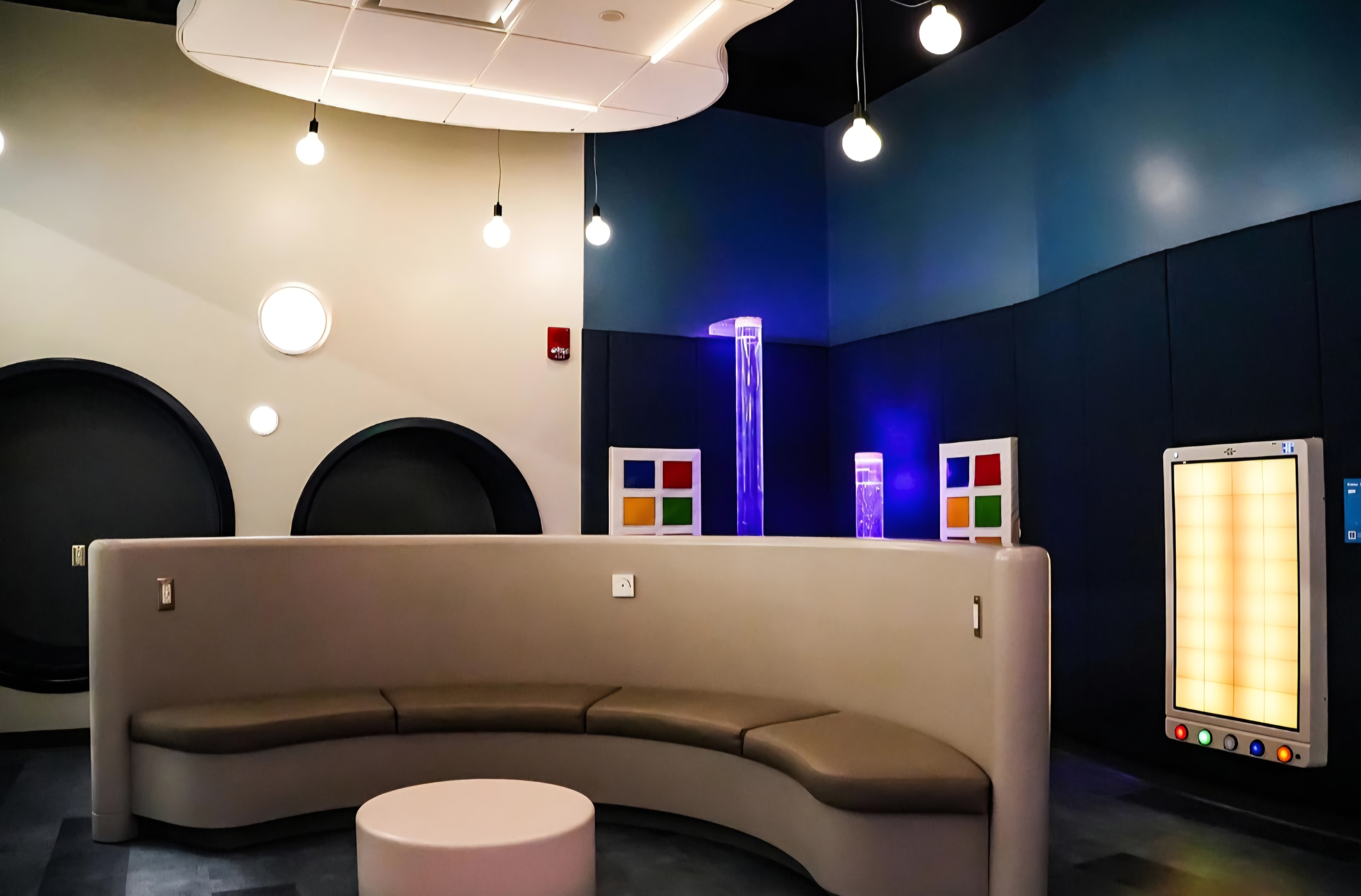
Manchester Airport has opened a new high-tech Sunflower Zone, providing dedicated sensory and quiet spaces for passengers who need somewhere to regulate, decompress or simply escape the intensity of the terminal before their flight.
And importantly, you don't need to pre-book it.
What's inside Manchester Airport's new sensory space?
Rather than creating a single room and assuming it will work for everybody, the new facility has been divided into three separate spaces.
Rooms 1 and 3 are sensory rooms, while Room 2 is specifically designed as a quiet room.
The two sensory rooms contain an impressive range of equipment, including bubble tubes, infinity mirrors, light projectors, adjustable coloured lighting and weighted and padded furniture.
Furniture has deliberately been chosen to allow people to sit, stand or lie down, recognising that different people regulate themselves in different ways.
Meanwhile, the separate quiet room takes almost the opposite approach. It has comfortable seating, low-level lighting and minimal sensory stimulation, creating somewhere to retreat from the noise and activity of the terminal.
There are also flight-information screens at the entrance, meaning families can keep track of their flight without having to choose between remaining in the calmer environment and checking departure information.
The new facility at a glance
Where: Terminal 2, Manchester Airport
Name: Sunflower Zone/Sunflower Room
Three separate spaces: two sensory rooms and one quiet room
Sensory equipment: bubble tubes, infinity mirrors and light projectors
Adjustable lighting: including brightness and colour
Furniture: weighted and padded, with options for sitting, standing or lying down
Quiet room: comfortable seating, low lighting and minimal stimulation
Flight screens: available at the entrance
Booking: no pre-booking is required.
Designed with people who understand sensory needs
Perhaps one of the most encouraging things about the project is who was involved in creating it.
The rooms were designed by sensory specialists AmbiSpace, with input from the National Autistic Society, Manchester Airport's special-assistance provider ABM and the Manchester Airport Accessibility Forum, which includes disabled airport users and advocates.
That consultation matters because there isn't one universal definition of a calming sensory environment.
Some autistic people may find lights, movement and bubbles regulating. Another person may need precisely the opposite: reduced light, reduced noise and somewhere still.
Emma Roberts of the National Autistic Society, who was involved in the consultation, explained that this difference was recognised from the beginning. The solution was therefore to provide distinct private spaces rather than one supposedly universal sensory room.
That's a valuable lesson for SEND provision well beyond airports.
Accessibility isn't about making everybody use the same solution. It's about providing people with meaningful choices.
Why airports can be particularly difficult for SEND travellers
Airports combine many of the things that can be challenging for people with sensory differences.
They're unpredictable while simultaneously demanding that passengers follow strict processes.
There can be queues at check-in, bag drop and security. Passengers encounter announcements, crowds, bright retail displays and unfamiliar environments. Security may involve removing clothing or belongings and, occasionally, physical searches.
Then there is the disruption to routine.
Manchester Airport itself advises autistic passengers that uncertainty can contribute to travel-related stress and suggests preparing people for the individual stages of an airport journey, such as check-in, security and boarding. It also recommends considering aids such as earplugs, noise-cancelling headphones and familiar comfort items.
The airport also participates in the Sunflower Lanyard scheme, helping staff identify passengers with non-visible disabilities who may need additional time or support.
The new sensory zone therefore isn't simply an attractive extra facility.
For some families, having a predictable place to retreat to could be the difference between an airport journey feeling manageable and feeling overwhelming.
The statistics show why accessible holidays matter
A 2024 Savanta survey commissioned by Transreport found that 64% of families containing a disabled person were choosing not to travel abroad that summer. Accessibility concerns extended to flying: 40% said they had avoided travelling by air because of accessibility worries, while 58% believed international airports did not provide adequate accommodation for disabled travellers.
The broader travel gap is visible in government statistics too.
Department for Transport figures for England show that in 2025 disabled adults made an average of 713 trips per person, compared with 901 trips among non-disabled adults — a difference of 21%.
Those figures cover travel generally rather than holidays specifically, but they illustrate a wider accessibility gap.
And when we look specifically at families with disabled children, the barriers to simply enjoying leisure time become even clearer.
Research published by disability charity Sense in 2026 found that 57% of parent carers struggled to find accessible holiday clubs for their disabled child. Only 6% of disabled children in responding local-authority areas were receiving holiday-club support. Sense estimates that more than 1.27 million disabled children aged 0–18 live in those areas.
Again, that research concerns school-holiday provision rather than overseas tourism. But together these statistics reveal something important: for many SEND and disabled families, opportunities that other families might take for granted can still require considerable additional planning.
A sensory room can make the whole family more confident about travelling
The significance of facilities like Manchester Airport's becomes clearer when we stop thinking about accessibility as simply getting someone physically from the terminal entrance onto an aircraft.
A genuinely accessible journey is also about dignity, predictability, choice and emotional wellbeing.
Imagine being a parent who knows that their child can become overwhelmed in crowded environments.
Before the holiday has even started, you're potentially thinking about parking, queues, security, noise, delays, food, toilets, boarding and what happens if your child becomes overwhelmed.
Knowing that there is a dedicated place available after security where your child can regulate could remove at least one element of that uncertainty.
And because Manchester Airport says the new spaces don't require advance booking, families don't necessarily have to predict beforehand whether they will need them.
They can simply use them when needed.
Accessibility should be part of the journey, not an afterthought
There has been encouraging progress at Manchester Airport beyond this new facility.
In September, the airport announced that the Civil Aviation Authority had awarded its special-assistance provision the highest "very good" rating, improving on its "good" rating for 2025. The CAA assessment covers services for passengers with reduced mobility and hidden disabilities.
The airport also operates Assisted Travel receptions and lounges, assistance call points and support through security and boarding.
The new Sunflower Zone adds another piece to that provision.
But perhaps its biggest contribution is the message it sends.
A person shouldn't have to avoid a family holiday because the journey isn't designed with their needs in mind.
Children and adults with SEND, autism, neurodivergence and disabilities have the same right to experience the excitement of discovering somewhere new, visiting family overseas or simply enjoying a week in the sunshine.
Making that possible sometimes requires major structural changes.
And sometimes it requires something comparatively simple: a quiet door to close, softer lighting, somewhere comfortable to lie down, and enough time and space to regulate before continuing the journey.
For families who have previously wondered whether flying is simply going to be "too much", Manchester Airport's new sensory zone could make that first step towards a holiday feel considerably more achievable.