The Purple Pound

Published · 14 min read
How businesses are missing out on billions by overlooking accessibility
Why accessible businesses have a commercial advantage, what the latest research tells us about disabled consumers' spending power, and how Buzzbo Marketplace is helping to bring businesses and customers together without barriers.
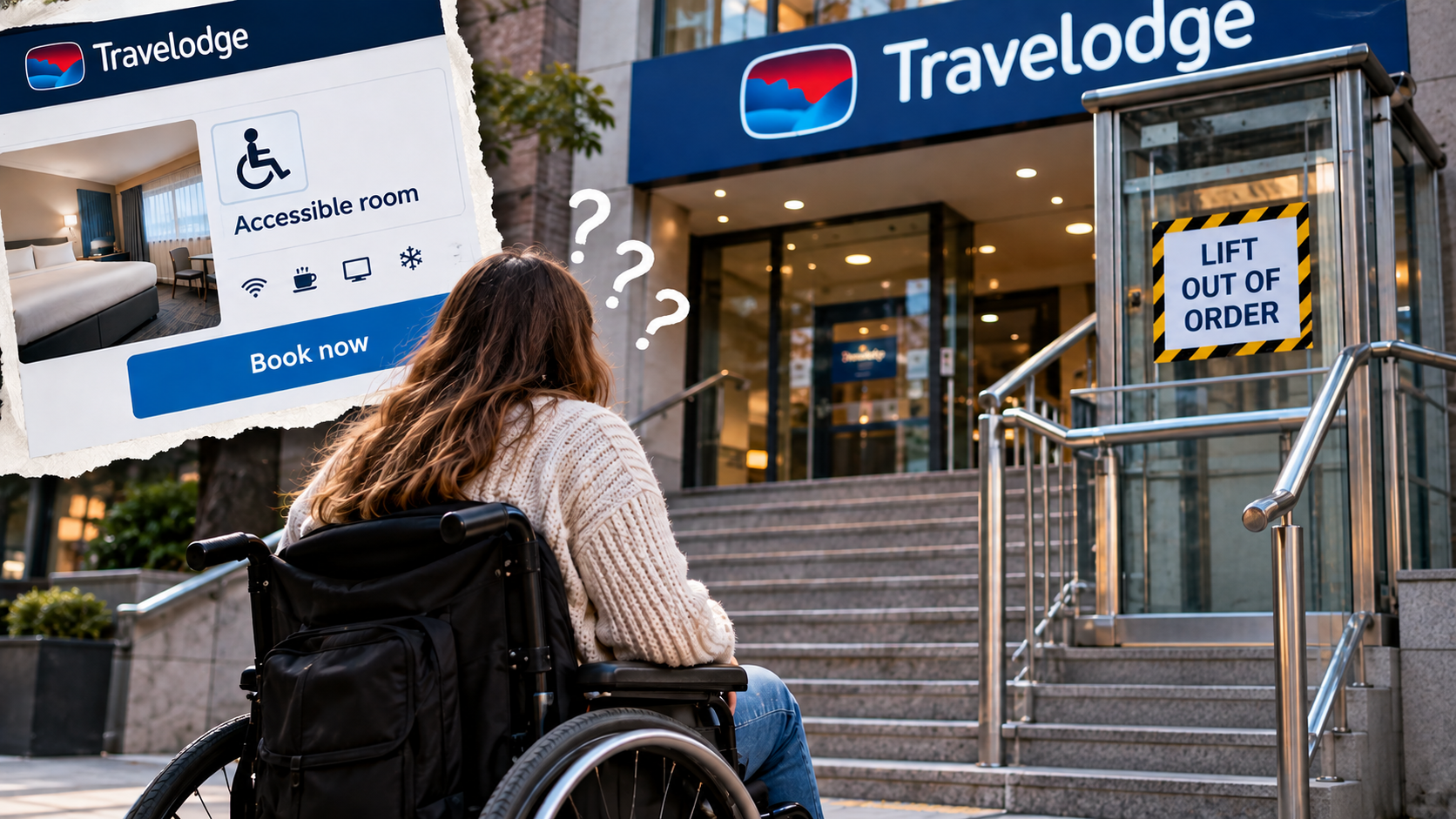
There is a huge commercial opportunity sitting in front of UK businesses, yet many are failing to recognise it. Every day, disabled people encounter barriers when trying to shop online, find somewhere to eat, book a holiday, discover a local service or simply access information about a business. These barriers do more than create frustration. They can prevent people from spending their money altogether, sending potential customers elsewhere and leaving businesses missing out on revenue they could otherwise have earned.
This is the reality behind what is known as the Purple Pound: the spending power of disabled people and households containing at least one disabled person. It is a market that businesses can no longer afford to overlook, particularly as disability becomes an increasingly significant part of the UK population. Yet despite the scale of the opportunity, accessibility is still too often treated as an optional extra, something to consider once a website has been built or a business has already established itself. At Buzzbo Marketplace, we believe that approach needs to change.
The Purple Pound: a £446 billion opportunity
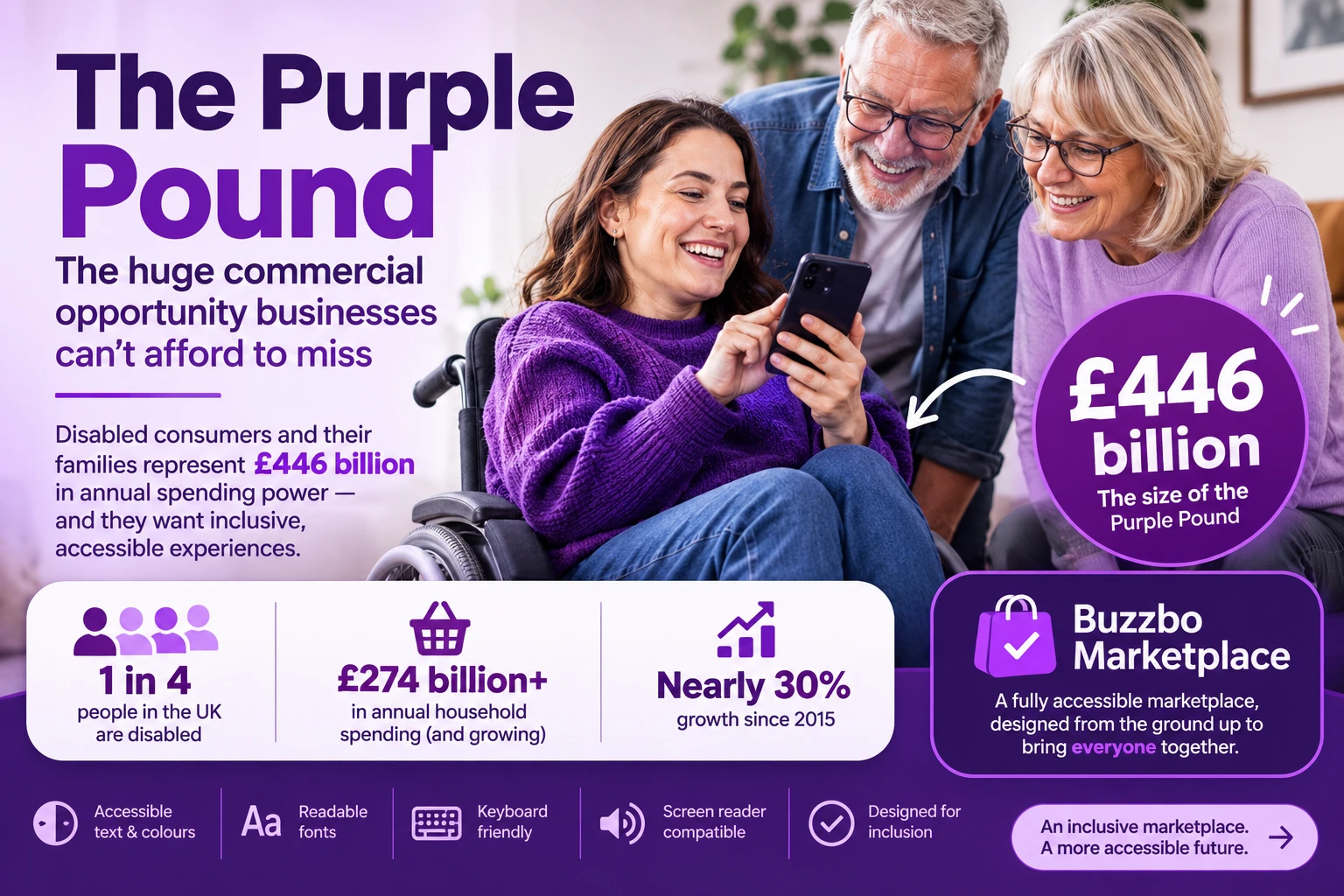
The scale of this opportunity is perhaps best demonstrated by the latest research from the University of Bristol's Personal Finance Research Centre and the Money Advice Trust. Their November 2025 research updated the widely quoted Purple Pound figure from approximately £274 billion to an estimated £446 billion a year.
That is a substantial increase, and it is important to understand what the figure actually represents. The £446 billion estimate is based on the combined annual household income, after housing costs, of UK households containing at least one disabled person, using 2023/24 Family Resources Survey data. It is not a calculation of money spent exclusively by disabled individuals, nor does it mean that the entire amount is additional consumer spending. It does, however, demonstrate the extraordinary economic significance of these households and the commercial audience businesses are potentially failing to reach.
The same research estimates that the Purple Pound's value has increased by nearly 30% in real terms between 2015 and 2024. This is particularly important because it demonstrates that the opportunity is not standing still. The number of people reporting a disability has also increased considerably, meaning that businesses which fail to consider accessibility risk overlooking an increasingly significant part of their potential customer base.
According to the Department for Work and Pensions' latest Family Resources Survey, published in March 2026, 16.7 million people in the UK were classified as disabled in 2024/25. That is approximately one in four people. A decade earlier, the equivalent figure was 12.9 million, meaning the number has increased by 3.8 million over that period. These are not small numbers, and they represent millions of people with everyday purchasing needs, interests and preferences who deserve the same opportunity to access products and services as everyone else.
For businesses, the message is straightforward: this is not a small or specialist audience. It is a substantial part of the population and a significant economic market. Making products and services accessible is therefore not simply about meeting an obligation or demonstrating good intentions. It is about ensuring that potential customers are not unnecessarily excluded from spending with your business.
How much are businesses losing through inaccessible websites?
One of the strongest illustrations of the commercial cost of exclusion comes from the Click-Away Pound research, which examined how disabled people and people with access needs experience online shopping. Its 2019 report estimated that UK online retailers could be missing out on approximately £17.1 billion in potential redirected spending every year because customers encountered websites they could not easily use.
The research found that 69% of surveyed disabled online consumers would click away from a website that was difficult for them to use. It also found that 83% limited their shopping to websites they already knew were accessible, while 86% said they had chosen to pay more for a product from an accessible website rather than purchase the same product more cheaply from a website that was harder to use. These findings reveal something particularly important: accessibility does not simply influence whether someone can complete a purchase. It can influence which businesses they trust, where they choose to shop and how much they are prepared to spend.
The £17.1 billion figure needs to be understood in context. It is an estimate of potential redirected online retail spending based on the 2019 survey, rather than a measurement of audited losses across all UK businesses today. Nevertheless, it provides a powerful indication of the financial consequences of digital exclusion. When customers cannot navigate a website, understand its information, interact with its features or complete a transaction, the business has effectively placed a barrier between itself and a willing customer.
Research commissioned by Business Disability Forum and carried out with Open Inclusion provides further evidence of this problem. Its research, involving 698 disabled consumers, found that more than 43% had abandoned shopping tasks without making a purchase. A remarkable 90% said that their purchasing decisions were affected by limitations in design, the information available or the way that information was presented. In addition, 65% agreed that barriers limited their choices of what to buy on a daily basis.
These figures are particularly concerning when we consider how many businesses invest in advertising, social media, search engine optimisation and marketing to attract new customers, only to send those customers to websites that may not be usable by everyone. Attracting someone to a website is only the first part of the customer journey. If the experience prevents them from finding what they need or completing their purchase, that marketing investment may never translate into a sale.
And perhaps one of the most important findings from the Click-Away Pound research is that only 8% of disabled customers who experienced difficulty using a website said they would contact the website owner about the problem. This means businesses may never receive a complaint or even realise that a potential customer has been lost. People often simply leave and find somewhere else to spend their money.
The state of online accessibility: why so many businesses are getting it wrong
The difficulty is not that accessibility is an unknown concept. It is that there remains a considerable gap between recognising its importance and actually delivering an accessible experience. Research published by WebAIM in 2025 examined one million website homepages and found that 94.8% had detectable accessibility failures against WCAG standards. Although this study covered websites internationally rather than exclusively in the UK, it demonstrates just how widespread the problem remains.
The most frequently identified issues included insufficient colour contrast, missing alternative text for images, incorrectly labelled form fields and links that did not provide meaningful information. These might appear to be relatively minor technical details, but for someone relying on a screen reader, navigating with a keyboard or needing clear visual contrast, they can make the difference between successfully using a website and being unable to access it.
The situation is also evident among some of Britain's largest retailers. A 2025 assessment by Level Access examined the websites of the UK's 100 most popular retail brands and found that 84% had issues on their homepages that could create critical barriers for disabled users. Even the most established businesses are therefore not immune to accessibility problems.
What this tells us is that accessibility cannot simply be assumed because a website looks modern, attractive or easy to use for someone without additional access requirements. A website can look perfectly functional while presenting significant barriers to someone else. This is why accessibility needs to be considered throughout the design and development process, rather than being left until customers begin experiencing problems.
It is also important to recognise that accessibility is about much more than wheelchair access. People have different visual, hearing, cognitive, neurological and physical needs, and these can affect how they interact with digital content. Readable fonts, appropriate colour combinations, clear language, predictable layouts, properly structured information and compatibility with assistive technology all contribute to making an online experience more accessible.
Disabled consumers are not shopping alone: the wider spending opportunity
Another important aspect of the Purple Pound is that its influence extends beyond individual purchasing decisions. Families and friends frequently make decisions together about where to shop, where to eat, which activities to enjoy and where to spend their leisure time. When one person in a group encounters an accessibility barrier, that barrier can influence the decisions of everyone accompanying them.
Consider a family planning a day out. They may be choosing between several attractions, restaurants or leisure facilities. If one venue cannot provide clear information about accessibility, or if someone in the family cannot comfortably access the experience, the group may decide to visit somewhere else. The business potentially loses not just one customer, but the spending associated with the entire group.
This wider purchasing influence is supported by the Business Disability Forum's research into disabled consumer behaviour. Its research found that 45% of disabled consumers experienced some limitation in their choice when booking or visiting a restaurant, café or pub. For leisure activities, including theatres, cinemas, concerts and attractions, that figure increased to 56%. When choosing holiday accommodation, 59% said their choices were limited to some extent because their access needs were not met.
The research also highlights the importance of recommendations and information shared between people. When choosing restaurants, 45% of respondents used friends, family or colleagues as a source of information. For leisure activities, 38% did so. This is commercially significant because it shows that decisions about where to spend money are often influenced by wider social networks, not simply by an individual's own experience.
It would be misleading to suggest that we can attach a precise additional spending figure to friends and family based on these findings. However, the evidence demonstrates why accessible experiences can influence group purchasing decisions and why businesses should consider the wider community around disabled customers.
For Buzzbo Marketplace, this is a particularly important opportunity. We want to make discovering businesses and services easier for people with additional needs, while also helping their families and friends find places where everyone can feel included. When accessibility information is easier to find, planning becomes easier, uncertainty is reduced and people can make more confident purchasing decisions.
The importance of trust, transparency and accessible information
One of the biggest trends emerging from disabled consumer research is the importance of knowing what to expect before making a purchase. For many people, choosing a business involves more than comparing prices or looking at photographs. They may need to understand whether a venue has step-free access, whether suitable facilities are available, whether staff can accommodate particular requirements or whether a service can be adapted to meet their needs.
When this information is missing, customers are left having to contact businesses individually, make assumptions or take the risk of arriving somewhere that cannot accommodate them. That additional uncertainty can make an otherwise straightforward purchase unnecessarily difficult.
The Business Disability Forum's research found that 90% of disabled consumers were affected at the purchasing decision stage by limitations in design, available information or how information was presented. This is an important finding because it shows that exclusion can happen long before someone reaches the checkout or walks through a business's front door.
There is also a strong relationship between accessibility and customer loyalty. Scope has previously reported that 70% of disabled people surveyed would not return to a business following poor customer service. While this is not a universal prediction of customer behaviour, it highlights how damaging negative experiences can be.
Businesses therefore need to move beyond simply saying that they welcome everyone. They need to communicate clearly, provide useful information and make reasonable efforts to understand the different requirements of their customers. Accessibility is not just about the physical or digital environment; it is also about how people are treated throughout their experience.
The changing expectations of businesses: accessibility from the beginning
There is a growing recognition that accessibility needs to be built into businesses rather than added when a problem arises. This is particularly relevant as more products, services and customer interactions move online.
The European Accessibility Act, which began applying on 28 June 2025, has also brought digital accessibility into sharper focus for many businesses providing covered products and services within the EU. In the UK, the Equality Act 2010 already places duties on service providers to make reasonable adjustments for disabled people. These are different legal frameworks, but both reinforce the importance of considering accessibility when designing and delivering services.
For digital businesses, the Web Content Accessibility Guidelines, commonly known as WCAG, provide an internationally recognised framework for making online content more accessible. They address areas such as perceivability, operability, understandability and robustness. Following these principles can help businesses identify and remove barriers that might otherwise prevent customers from using their websites.
However, compliance and genuine inclusion should not be confused. A website can work towards technical standards and still offer a frustrating experience if the information is confusing, accessibility details are missing or the customer journey has not been designed with real people in mind.
The strongest approach is to involve people with different access needs in the development process and listen to their experiences. Accessibility should be an ongoing commitment, not a one-off exercise.
How Buzzbo Marketplace is changing the experience
This is exactly why we created Buzzbo Marketplace.
We recognised that there was an opportunity to bring businesses and consumers together in a way that places accessibility at the heart of the experience. Too often, people with additional needs have to search through countless individual websites, trying to establish whether a business is suitable for them, whether the information is reliable and whether they will be able to access the products or services being offered.
We wanted to create somewhere that makes this process easier.
Buzzbo Marketplace has been designed with accessibility as a fundamental part of its foundations. Its text, colours, fonts and overall presentation have been developed with different access needs in mind. Accessibility has not been treated as an afterthought or an optional addition to an existing platform. It has been central to the way we have approached its creation.
Our ambition is to provide a centralised marketplace where people can discover businesses, products and services without having to navigate a collection of unrelated websites with completely different approaches to accessibility. By bringing these businesses together, we want to make it easier for consumers to find what they are looking for while helping businesses become more visible to an audience they may otherwise struggle to reach.
For businesses, this represents an opportunity to put their products and services in front of people who are actively looking for inclusive experiences. For consumers, it creates a more straightforward way to discover businesses and explore what is available. For families and friends, it offers another way to find businesses that recognise different needs and understand the importance of inclusion.
We also believe that accessibility should benefit everyone. Clear information, readable text, sensible layouts and straightforward navigation are not useful exclusively to disabled people. They can improve the online experience for older customers, people with temporary injuries, people accessing websites on smaller screens and anyone who simply appreciates information that is easy to understand.
Buzzbo Marketplace is about making that experience more accessible from the outset.
The commercial opportunity businesses cannot afford to ignore
When we bring all of this research together, the commercial opportunity becomes difficult to dismiss. The UK has 16.7 million disabled people, approximately one in four of the population. Households containing at least one disabled person have an estimated annual income of £446 billion. Research into online shopping has identified £17.1 billion in potential redirected spending because of inaccessible websites, while separate consumer research shows that more than 43% of disabled respondents have abandoned shopping tasks without purchasing.
These figures come from different studies, years and methodologies, so they should not be added together or treated as one measurement of lost revenue. What they collectively demonstrate, however, is that accessibility has a genuine economic dimension.
Businesses spend considerable time and money attracting customers, building their reputations and encouraging repeat purchases. Yet when accessibility is overlooked, they risk excluding people who want to use their services and have the means to pay for them. They may also miss recommendations, repeat custom and the wider purchasing decisions made by families and friends.
The opportunity is not about expecting businesses to make unrealistic promises or suggesting that accessibility automatically guarantees increased sales. It is about removing unnecessary barriers, making information easier to access and ensuring that more people have the opportunity to become customers.
For smaller businesses in particular, being discoverable in a centralised marketplace could help them connect with people they might not otherwise reach. It gives them an opportunity to communicate what they offer and become part of a wider movement towards more accessible and inclusive commerce.
A marketplace built around the belief that everyone deserves access
The Purple Pound is more than a financial statistic. Behind those billions are millions of people who want to shop, travel, eat out, enjoy activities, discover new businesses and take part in everyday life without constantly having to overcome barriers.
They should not have to spend hours searching for information that other customers can access in seconds. They should not have to abandon a purchase because a website is difficult to navigate. And they should not have to question whether a business has considered their needs before deciding whether they can visit.
At Buzzbo Marketplace, we believe there is a better way.
We have created a platform that brings businesses and consumers together in one centralised place, with accessibility considered from the very beginning. We want to help businesses reach a wider audience, help consumers discover more opportunities and make finding inclusive products and services a simpler experience.
The research makes one thing clear: the opportunity is already there. The spending power exists, the demand exists and the need for better accessibility is undeniable. What is needed is a more inclusive way of connecting businesses with the people they are currently missing.
Buzzbo Marketplace is here to help make that happen. Because accessibility should never be an afterthought, inclusion should never be a privilege, and everyone deserves the opportunity to take part.