When “Accessible” Isn’t Accessible
27 September 2026 · 9 min read
The Travelodge Story That Shows Why Trust Matters
Booking a hotel room should be simple.
You choose where you want to stay, select the room that meets your needs, pay, and arrive expecting to receive what you booked.
But for disabled travellers, there can be another question hanging over the entire journey:
Will the “accessible” room actually be accessible when I get there?
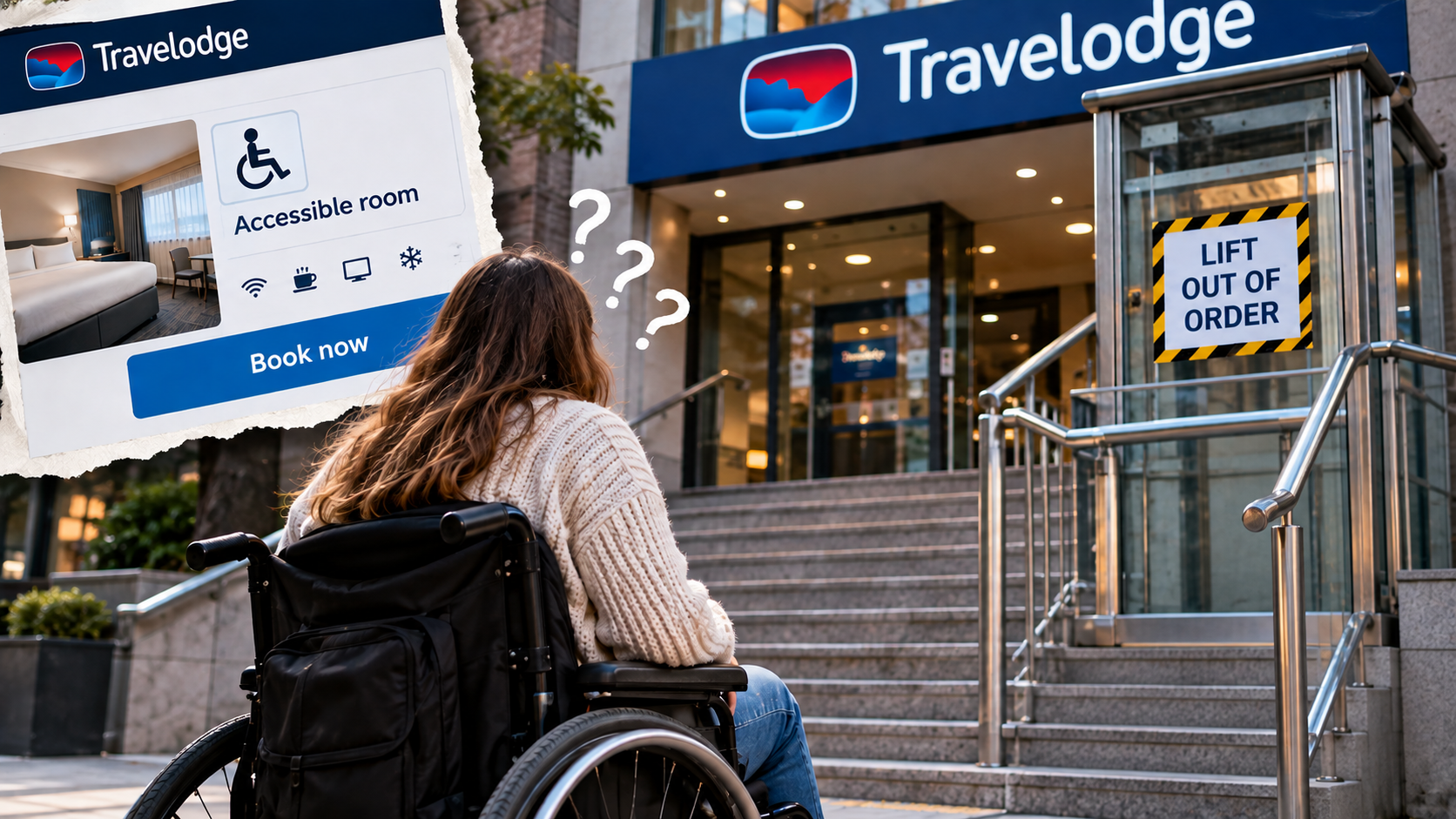
For wheelchair user and content creator Isabel Cantos, that fear became reality when she arrived at a Travelodge after booking an accessible room — only to discover that the lift providing access to the hotel was out of order.
The alternative?
Steps.
For someone relying on a wheelchair, that doesn't amount to an inconvenience. It can mean the hotel you've booked is effectively inaccessible.
And Isabel's experience has quite rightly struck a nerve. Her video documenting what happened has been viewed more than a million times, drawing attention to a much bigger problem in accessible travel: disabled people are still being asked to place enormous trust in accessibility information that can determine whether they can actually use what they've paid for.
She booked an accessible room. But she couldn't access the hotel.
According to Isabel's account, she booked an accessible room at Travelodge's Edinburgh Central Queen Street hotel.
When she arrived, however, the external lift providing access to the hotel wasn't working.
Travelodge's hotel page currently carries an important-information notice stating that the external lift is out of service and that access is via steps only. It specifically warns that guests with mobility requirements, including wheelchair users, may therefore be unable to access the hotel.
The problem raised by Isabel wasn't simply whether that information existed somewhere on the website.
It was whether it was communicated clearly enough during the booking journey.
After the incident, Isabel retraced the online booking process. She said she could select an accessible room and progress as far as the payment page without initially seeing a warning about the broken lift.
She eventually found a warning on the hotel's main page, but said it required searching for the hotel separately and scrolling down the page.
That's a crucial distinction.
Accessibility information isn't useful simply because it technically exists somewhere.
It has to reach the person who needs it, at the point they are making their decision.
If a wheelchair user can select an accessible room, enter their details and move towards payment without being clearly told that they may not be able to enter the building, something has gone badly wrong in the information journey.
Isabel later said that a Travelodge manager contacted her and reassured her that the company was looking into what had happened.
What happens when accessibility information fails?
It's easy for somebody who doesn't depend on accessibility features to view a broken lift as an inconvenience.
For a wheelchair user, it can change everything.
A non-disabled guest discovering a lift is broken might be able to use the stairs.
A wheelchair user may have no alternative at all.
And the consequences extend far beyond reaching a bedroom.
Accessible travel often involves significant planning before someone even leaves home: accessible transport, suitable bathrooms, step-free routes, wheelchair space, parking, assistance, equipment, medication and contingency plans can all be part of making a trip possible.
VisitBritain's research into travellers with mobility requirements highlights just how important detailed accessibility information is. It found that information, measurements, photographs, videos and virtual tours can be essential when people with mobility needs plan travel. Its wider accessibility research also identifies lifts, where applicable, among the critical accessibility features travellers look for.
So when the information at the centre of those plans turns out to be inaccurate, incomplete or difficult to find, the impact isn't merely frustration.
It can mean stress, physical pain, additional expense, loss of independence, embarrassment, missed events and, in some circumstances, having to abandon the trip altogether.
And perhaps one of the most damaging consequences is something less visible:
you stop trusting the next booking.
This isn't the first time
Isabel's experience shouldn't be viewed in isolation.
There have been several publicly documented cases involving disabled guests encountering accessibility problems at Travelodge properties.
In 2023, wheelchair user Kat Watkins booked an accessible room at a Travelodge in Hounslow while travelling from Wales to attend a concert in London.
Kat also required a ventilator overnight.
When she arrived, she said she was told her accessible room wasn't available. An alternative room wasn't suitable because her wheelchair couldn't access the bathroom, while moving to another Travelodge would have disrupted the carefully planned accessible journey she had arranged.
Eventually, after returning from the concert, Kat ended up sleeping on a sofa in the hotel's dining area.
She subsequently told ITV News Wales that the experience left her in pain and damaged her confidence in travelling, saying the thought of staying in a hotel filled her with dread.
Then, in 2024, another incident was reported in Edinburgh.
Disabled cousins Angela Coulton and Nicola Honey were staying at a Travelodge when the lift serving their room broke down. They described having to make their way up and down four flights of stairs, at points crawling or moving on their backsides.
They described the experience as humiliating and dehumanising.
Travelodge apologised, saying it had fallen short of its usual standards, and reportedly provided a refund and voucher.
There have been other complaints too.
In 2021, wheelchair user Alice Bigsby-bye and their partner Beau Brannick publicly challenged Travelodge over their experience with an accessible room. Their campaign generated tens of thousands of petition signatures and prompted other disabled travellers to share similar experiences. Travelodge subsequently apologised and said it was reviewing accessibility with a charity partner.
Going further back, Travelodge itself published a response to a case involving Kirsty Mahoney and her parents, where a database error resulted in two bookings being authorised when only one disabled room was actually available. Travelodge apologised for what it described as a distressing and uncomfortable stay.
These cases don't tell us exactly how many times this has happened.
There is no reliable public database recording every occasion on which somebody has booked accommodation described as accessible and subsequently found that it wasn't suitable or accessible to them.
But the evidence tells us the problem extends beyond a handful of viral posts.
This is a wider industry problem
UK government research into disabled people's experiences of private-sector products and services found significant barriers before customers even reached a venue.
Among respondents who had experienced barriers, 36% encountered problems while initially searching and researching products or services, while 50% experienced barriers when trying to find information about a specific product or service that met their needs.
Within entertainment and hospitality, 58% of respondents who identified that sector as one of their three most inaccessible areas reported barriers involving UK holiday accommodation.
One respondent with a mobility impairment described choosing holiday accommodation advertised as wheelchair accessible only to encounter major accessibility problems on arrival.
That gets to the heart of the issue.
“Accessible” isn't enough information.
Accessible to whom?
Does it have step-free access from the street?
What's the door width?
Is there an accessible bathroom?
Is there a roll-in shower?
Are there grab rails?
Can someone transfer beside the bed?
Is the lift large enough for a powered wheelchair?
Is accessible parking available?
And crucially:
Are those facilities actually available today?
Accessibility isn't a single tick box.
The real damage is the loss of trust
Imagine booking your next hotel knowing that getting the accessibility information wrong could leave you stranded outside.
Suddenly, clicking Book Now doesn't feel straightforward.
You might phone the hotel.
Then phone again.
You might ask somebody to confirm the room.
You might search Google Maps photographs.
You might read reviews looking specifically for wheelchair users.
You might message the venue on social media.
You might take screenshots of the accessibility information in case it's different when you arrive.
And even after doing all that, you may still wonder:
“Can I trust this?”
That's an exhausting burden to put on disabled customers.
A non-disabled traveller can generally book a hotel on the assumption that they'll physically be able to enter it and reach their room.
For many disabled travellers, that assumption cannot always be taken for granted.
And every story like Isabel's chips away at that trust a little more.
Businesses need to understand that accessibility information is part of the product
Travelodge says it has accessible rooms in 98% of its hotels, and its website allows customers to specifically select an accessible room when booking. Its accessibility guide also acknowledges that individual hotels differ and advises customers to contact properties when they require additional details.
The company has also publicly described work to improve accessible rooms, booking information and staff training. Its 2025 Better Future report says clearer room descriptions and improved website filters are intended to help customers make more informed choices.
Those are important ambitions.
But Isabel's experience demonstrates why accessibility can't stop with providing an accessible room.
The entire customer journey has to work.
If the accessible entrance depends on a lift and that lift breaks, the accessibility status of that property has changed.
The digital information needs to change with it.
And customers who have already booked and whose stay may be affected need clear, proactive communication.
The principle should be simple:
Don't make disabled people discover an accessibility problem when they arrive.
Give them accurate information and let them make their own decision.
This is exactly why we built Buzzbo
At Buzzbo, we believe disabled people deserve something that has been missing from online booking for far too long:
confidence.
Not vague claims.
Not a wheelchair symbol with no explanation.
Not “accessible” as a marketing label.
Actual information.
Because two people with the same disability may have completely different accessibility requirements. What works perfectly for one person may make somewhere impossible for another.
That's why Buzzbo is being built around trust, knowledge and accountability.
We want people to understand what they're booking before they book it.
We want accessibility information to be meaningful enough for someone to decide for themselves whether a hotel, restaurant, attraction or experience meets their individual requirements.
And importantly, we want businesses to be accountable for the accessibility information they provide.
Because when somebody tells Buzzbo that their venue has step-free access, an accessible toilet, suitable parking or another accessibility feature, that information matters.
A disabled person's plans may depend on it.
The objective isn't to promise that every venue will work for every disability. No platform can honestly make that promise.
It's to give people the information they need to make an informed choice — and greater confidence that what they book is what they'll find when they arrive.
Accessibility shouldn't require a leap of faith
Isabel Cantos's experience went viral because the contradiction is so obvious:
She booked an accessible room and arrived at a hotel she couldn't access.
But behind the viral video is a much bigger issue.
For disabled people, inaccurate accessibility information doesn't simply create a disappointing customer experience.
It can determine whether they can enter a building, use a bathroom, attend an event, sleep safely, travel independently or take the trip at all.
And every time somebody books something described as accessible only to discover otherwise, trust in the entire booking process suffers.
We think disabled people deserve better.
They deserve detailed information.
They deserve transparency.
They deserve businesses that stand behind the accessibility information they provide.
And above all, they deserve to be able to book somewhere without wondering whether “accessible” really means accessible when they arrive.
That's why we're building Buzzbo.
Because accessibility shouldn't be something you discover when you get there.
You should know before you go.